CHARACTERISTICS

Broad range, strong retail, tough price competition

Tool manufacturers mostly produce in series and sell a large share through retail. Margin is therefore made less in the individual order than in the interplay of product range, price and availability.

The range grows faster than revenue. New variants, sets and special versions are added, while old items are rarely discontinued. Many items contribute little to the contribution margin but tie up inventory, set-up time and maintenance effort.

Retail negotiates too. Specialist dealers, DIY stores and online platforms demand terms, promotions and high availability. Without clear consideration in return, margin gradually migrates to the dealer.

Price pressure comes from Asia. Competitors with different cost structures set prices in the entry-level and mid-range segments. Anyone without a clear position is compared on price alone.

Availability sells. Retail lists what is available. High availability requires planning that does not raise inventories across the board but holds them where they are sold.

Market situation · As of October 2026

The bottom has been reached, growth is not returning

German precision tool manufacturers produced goods worth around EUR 8.5 billion in 2025, around 7 per cent less than in the previous year. For 2026, the VDMA expects consolidation at this level, but no growth. Exports to China fell by 9 per cent in 2025 and within Europe by 4 per cent; only the USA grew slightly, by 2 per cent.

In Switzerland, order intake in the tech industry was 12.1 per cent above the previous year in the first half of 2026. SME revenues, however, fell by 3.8 per cent over the same period, and at 81.1 per cent, capacity utilisation was well below the long-term average of 85.6 per cent.

When the market is not growing, your own earning power decides. Those who put their range, terms and inventories in order now gain room for manoeuvre before price pressure uses it up.

Sources: VDMA Precision Tools, annual press conference of 27.01.2026; Swissmem, press release of 24.08.2026.

EUR 8.5 bn

Production of precision tools in Germany 2025

−7%

compared with the previous year

−9%

Exports to China 2025

+2%

Exports to the USA, the largest foreign market

−3.8%

Revenue of Swiss SMEs in the first half of 2026

81.1%

Capacity utilisation in Switzerland, long-term average 85.6%

Early warning signals

How to recognise that action is needed

At tool manufacturers, problems rarely show up first in revenue. They show up in the product range, in inventories and in dealer terms.

  • The gross margin falls although revenue remains stable.
  • A long tail of items without contribution margin. Many items sell rarely but are still produced, stored and maintained.
  • Inventory coverage keeps growing, and yet items in demand are missing.
  • Dealer terms without consideration. Discounts, bonuses and advertising allowances grow without volume, listing or placement increasing to the same extent.
  • Availability falls, and retail lists competitors.
  • Price increases do not stick because terms eat them up again.

If several of these signals apply, a sober assessment is worthwhile before the figures force one.

More about the Corporate Health Check
Schematische Darstellung typischer Frühwarnsignale bei Werkzeugherstellern: Handel, Lieferfähigkeit, Sortiment, Preise und Erfolgsrechnung

Levers

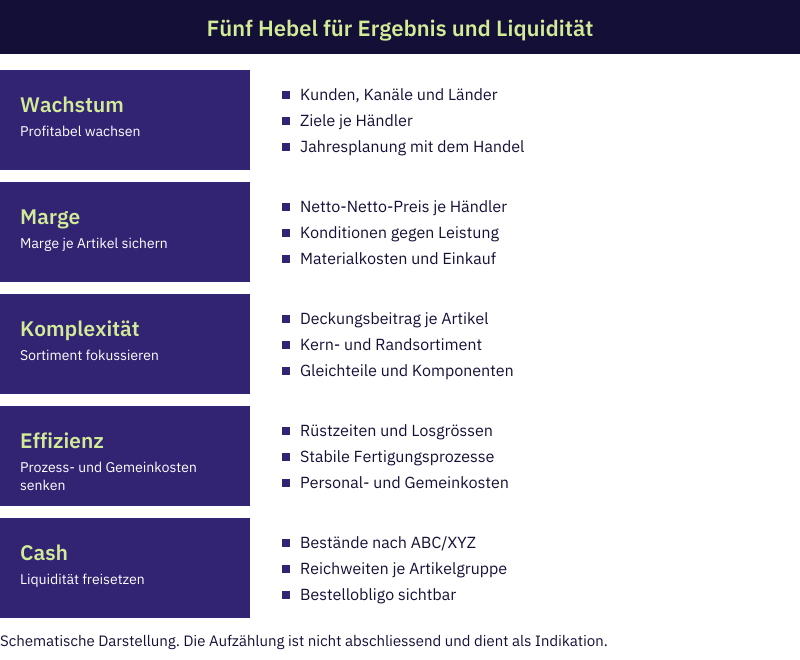
Five levers for earnings and liquidity

Earnings and liquidity rarely depend on a single department. Growth, margin, complexity, efficiency and cash influence each other, which is why we look at them together.

Growth. We show with which customers, channels and countries you can grow profitably and align dealer management accordingly: with targets per dealer, joint annual planning and sales management that goes beyond the listing. If new segments or markets are to be opened up, we realign positioning and sales with your management team as part of a transformation.

Margin. We make visible what remains of the list price after discounts, bonuses and allowances, and tie terms to consideration in return. This is complemented by price positioning per range tier and by purchasing: bundled requirements, renegotiated terms and reviewed make-or-buy decisions. Such measures are typically part of an optimisation with which a fundamentally healthy company strengthens its earning power.

Complexity. A product range analysis shows revenue, contribution margin and complexity costs per item. On this basis, we streamline the range, define the core and peripheral range and standardise components. Why complexity costs earnings and how a focus on the core business succeeds is described in our article Peak performance through strategic focus.

Efficiency. In production, we shorten set-up times, stabilise processes and create planning that balances batch sizes and availability. We also review personnel and overhead costs in production and administration. How we work with your teams is described under Operational Excellence.

Cash. At tool manufacturers, inventories are often the largest block of capital. We steer them using ABC/XYZ logic, set coverage targets per item group and make purchase commitments visible. If liquidity is already tight, working capital becomes the central building block of a restructuring.

Fünf Hebel für Ergebnis und Liquidität bei Werkzeugherstellern: Wachstum, Marge, Komplexität, Effizienz und Cash mit typischen Ansatzpunkten

KPIS

Which KPIs management at tool manufacturers should see every month

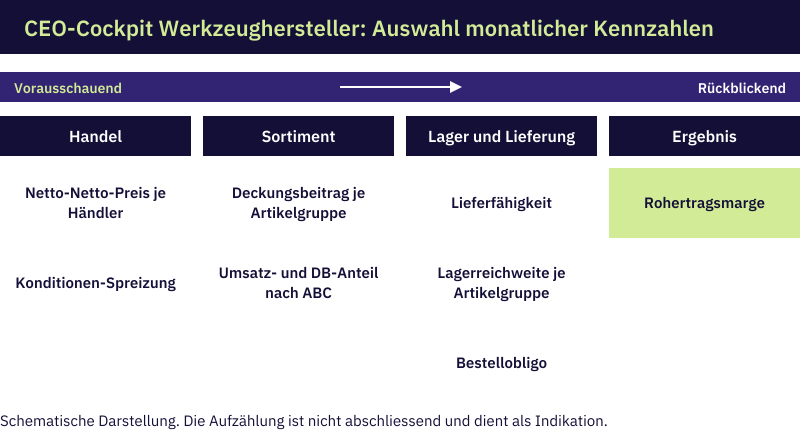
A few reliable KPIs are enough to steer a tool manufacturer. What matters is that they are regular, comparable and forward-looking.

  • Contribution margin per item group: shows which parts of the range carry the margin and which consume it.
  • Share of revenue and contribution margin by ABC: shows how strongly revenue and earnings are concentrated on a few items.
  • Inventory coverage per item group: shows how many days the inventory lasts at current sales.
  • Availability: the share of order lines delivered immediately from stock.
  • Net-net price per dealer: the list price minus all discounts, bonuses and allowances.
  • Spread of terms: the difference in net-net prices between comparable dealers.
  • Purchase commitments: make future cash outflows visible before they occur.
  • Gross margin: summarises all these figures; its trend shows whether the measures are working.
CEO-Cockpit Werkzeughersteller: Auswahl monatlicher Kennzahlen zu Handel, Sortiment, Lager und Lieferung sowie Ergebnis

The selection is not exhaustive; which KPIs fit depends on the business model. In the CEO cockpit, we bring these KPIs together on three levels, from management to the core process.

More about the CEO cockpit

Our key topics

With tailored approaches and proven methods, we support you in aligning and developing your company — independently, and starting from your current economic situation.

Transformation: engineering and office area of an industrial company

Transformation

Sharpen your strategy and develop a holistic alignment to realize growth opportunities.

Learn more
Optimization: production area with assembly workstations and material flow

Optimization

Increase your problem-solving capacity and develop your organization from mediocrity to peak performance.

Learn more
Restructuring: production hall with machinery and operator workstations

Restructuring

Secure your company's viability through structural interventions and sustainable earnings optimization.

Learn more
Turnaround: production area of an industrial company with machinery and employees in motion

Turnaround

Secure your company's liquidity and continued existence and restore its earning power for the long term.

Learn more

FROM PRACTICE

Two tool manufacturers, two starting points

Fallbeispiel Sanierung bei einem Elektrowerkzeughersteller

Turnaround at a power tool manufacturer

A long-established power tool manufacturer with revenue of around EUR 200 million had lived for more than 30 years from a patent-protected innovation. When patent protection expired, competitors offered comparable products at significantly lower prices. Strategic focus, reduced item complexity, a sales force that actively sells again and a socially responsible workforce restructuring have set a new course.

Read the case study
Restrukturierung eines Industrieunternehmens

Chief Restructuring Officer at a tool manufacturer

On behalf of the owning family, the loss-making business of a tool manufacturer with around 300 employees was to be returned to profit at short notice. Measures implemented included a liquidity plan, immediate actions in prioritised fields, lower inventories and savings in purchasing, a sharpened positioning and a planning system for sales.

Learn more

EXPERIENCE

Management and hands-on experience from industry

Our team combines management experience with technical, hands-on experience from industry. We know manufacturing companies not only from analyses but also from being responsible for results, employees and customers. That is why we speak the same language as your management and your production, and our solutions work in everyday operations.

More about us

FREQUENTLY ASKED QUESTIONS

Frequently asked questions about consulting for tool manufacturers

Which tool manufacturers does 10-P Consult work for?

For manufacturers of hand tools, power tools and precision tools with around 30 to 500 employees in German-speaking Switzerland and southern Germany. Typical features are a broad product range, series production and sales through specialist dealers, DIY stores and online platforms.

How do you approach a product range clean-up?

We analyse sales, contribution margin and complexity costs per item and decide for each product group whether an item stays, is replaced or is only made to order. Revenue risk and customer impact are quantified before every decision.

How do you improve dealer terms?

We make the net-net price per dealer visible and compare it with volume, listing and placement. The result is a system of terms that rewards performance rather than habit.

Is in-house production still worthwhile?

That depends on the item. We assess make-or-buy for each product group by cost, quality, availability and protection of know-how. The answer is often a combination: in-house production at the core, sourcing or partnerships for the peripheral range.

What if the situation is already critical?

Then securing liquidity takes priority. On request, we take over interim management or the role of Chief Restructuring Officer.

More about turnaround

How does a collaboration begin?

With an assessment of where you stand. The Quick Health Check takes five minutes to complete and shows what state your company is in and which fields of action offer the greatest leverage – as a five-page profile, reviewed by an experienced consultant and free of charge.

ASSESSMENT

Where does your company stand?

The Quick Health Check takes five minutes to complete and shows what state your company is in and which fields of action offer the greatest leverage – as a five-page profile, reviewed by an experienced consultant and free of charge.