Typical weak points in the core value-creation process

Delivery dates and lead times that nobody can reliably commit to

Order scheduling that is overturned every day, and no transparency along the value chain

Productivity and staff deployment below what machines and employees could achieve

Waste and quality costs: searching, waiting, rework, scrap, high inventory discrepancies

Analysis

Step 1: Identify the core value-creation process and its weak points

We map the core value-creation process – from quotation through work preparation, procurement and manufacturing to delivery – and make visible where it falters: in delivery reliability, order scheduling, staff deployment, productivity, lead times, waste or quality.

To do this, we work on site: with work sampling, analysis of machine running times and operating data, and conversations with supervisors and employees. Which topics take priority differs from company to company.

The result is a prioritised list of weak points and their causes – not a collection of symptoms.
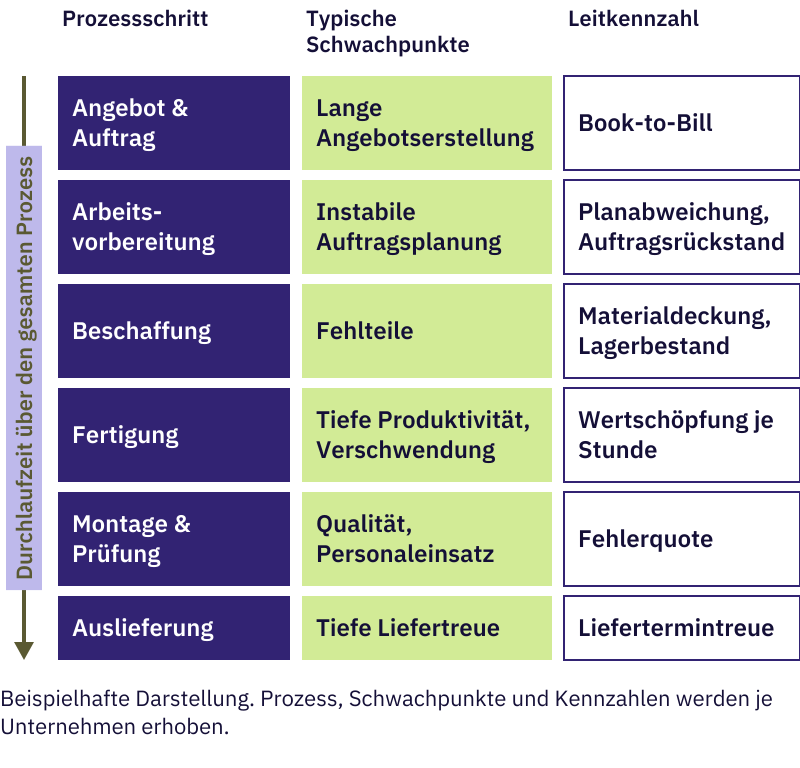
Kernwertschöpfungsprozess vom Angebot bis zur Auslieferung mit typischen Schwachpunkten und Leitkennzahlen je Prozessschritt

Implementation

Step 2: Identify and implement measures

We derive the measures from the causes – for example stable production planning, better material flow and a new layout, order and cleanliness at the workplace, shorter set-up times, reducing order backlogs or making consistent use of the existing ERP system.

Implementation takes place together with your supervisors and team leaders, area by area. Experience from the first area can thus be transferred to the next – and the organisation learns to solve problems itself.

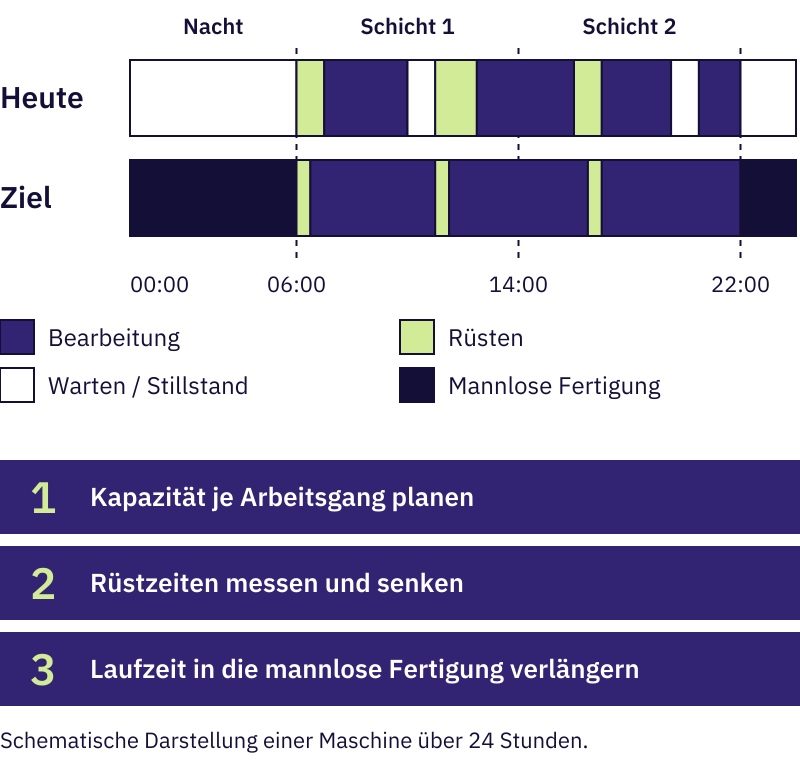
Maschinenbelegung über 24 Stunden heute und im Ziel: Kapazität je Arbeitsgang planen, Rüstzeiten senken, Laufzeit in die mannlose Fertigung verlängern

Anchoring

In parallel: transparency over operational key figures

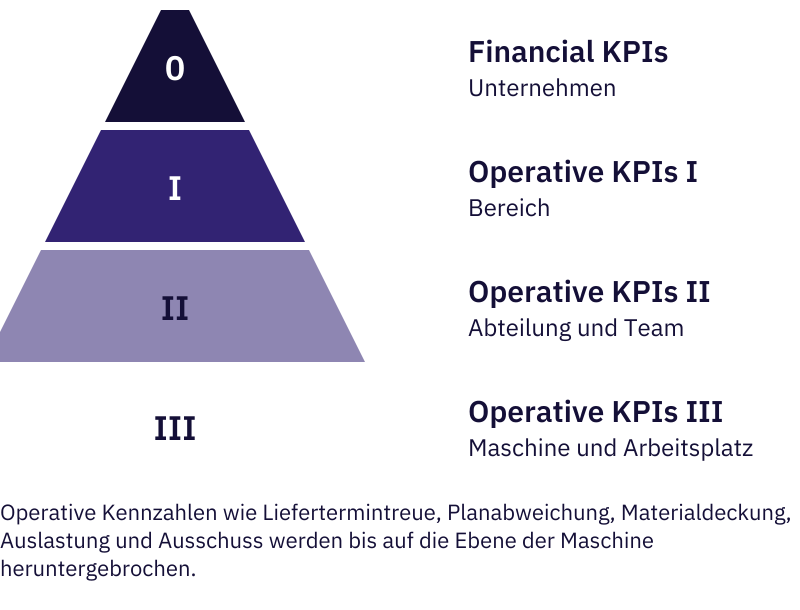
In parallel, we create transparency over the key figures along order processing – such as on-time delivery, plan deviation, material availability, capacity utilisation and scrap – with target values and fixed routines.

Short, regular meetings where value is created make deviations visible while they are still small. This keeps the optimisation anchored in day-to-day work, even after we have left.

Vier Kennzahlen-Ebenen: Financial KPIs für das Unternehmen, darunter operative Kennzahlen für Bereich, Abteilung und Team bis zu Maschine und Arbeitsplatz

THE DIFFERENCE: shop floor, not office

Why operational excellence works differently in industrial SMEs

Many approaches come from large-scale series production or from administration. An SME with high-variety one-off and small-batch production has different levers: few key people, machines for many different parts, orders with individual requirements.

That is why we start with planning, set-up times, material availability and leadership – not with tools that require a large organisation.

As in all our mandates, the methods stay in the company. Your supervisors and team leaders learn to solve problems themselves.

More about Institutional Learning
10-P Modell Strategieentwicklung
House of Excellence

RESULTS: what came of it

50 percent more output with a smaller workforce

Special machinery manufacturer with around 80 employees: output in production rose by 50 percent with a workforce 30 percent smaller – through production planning, layout, system support and new warehouse management.

How big the lever is depends on the starting position: on the business model, the parts spectrum and how much transparency already exists. That is why we do not quote blanket target values but derive them in the assessment.

The impact comes where transparency, clear responsibilities and consistent leadership come together.

Read the case study

ASSESSMENT: where is your lever?

Find out where your biggest lever lies

Not every productivity problem is a production problem. The causes often lie in order processing, in the product range or in cost calculation.

You decide how we support you: by leading individual fields of action, in workshops with your managers or with operational responsibility.

If you would like an initial assessment first, use the Quick Health Check: completed in five minutes, reviewed by an experienced consultant as a five-page profile and free of charge.

Start the Quick Health Check
Hebel für mehr Produktivität

Our key topics

With tailored approaches and proven methods, we support you in aligning and developing your company — independently, and starting from your current economic situation.

Transformation

Sharpen your strategy and develop a holistic alignment to realize growth opportunities.

Learn more

Optimization

Increase your problem-solving capacity and develop your organization from mediocrity to peak performance.

Learn more

Restructuring

Secure your company's viability through structural interventions and sustainable earnings optimization.

Learn more
Sanierung: Fertigungsbereich eines Industrieunternehmens mit Anlagen und Mitarbeitenden in Bewegung

Turnaround

Secure your company's liquidity and continued existence and restore its earning power for the long term.

Learn more

FREQUENTLY ASKED QUESTIONS

Frequently asked questions about operational excellence

What does operational excellence mean?

Operational excellence describes a company's ability to deliver its performance reliably, efficiently and with consistent quality while continuously improving. In industrial SMEs, this mainly means on-time order processing, high machine running times, short set-up times and appropriate inventory levels.

How does operational excellence differ from lean management?

Lean management provides many tools, for example to avoid waste. Operational excellence is the broader ambition: tools, key figures and leadership interlock so that improvement becomes routine.

Does it require new software or machines?

Usually not as a first step. The biggest levers generally lie in planning, set-up times, material availability and leadership. Investments pay off once it is clear where the bottleneck is.

Which companies is the approach suitable for?

For manufacturing SMEs with one-off, variant and small-batch production, particularly in machinery and plant engineering, metalworking and tool manufacturing in German-speaking Switzerland and southern Germany.

Do we need a new ERP system for this?

Usually not. In many companies, only a small part of the existing system is used. We first ensure clean master data, clear processes and use of the existing functions. Whether a new solution pays off is decided only afterwards.

What we offer

Institutional Learning

Five forms of collaboration, from workshops to interim leadership. The goal is always the same: your organisation solves its problems on its own in future.

Workshops and seminars

Methods for your managers on the fundamental questions of corporate management, held in-house or as open courses.

Learn more

Sparring and coaching

We support owners and managing directors as a sparring partner while they align their organisation for peak performance under their own direction. Responsibility stays with you.

Learn more

Advisory board

We serve on formal or informal boards, whether advisory, supervisory or board of directors, at the frequency you choose and in the spirit of helping you help yourself.

Learn more

Classic consulting

Diagnosis, concept and support during implementation, for example with the Corporate Health Check or by building a CEO cockpit.

Learn more

Interim leadership

As part of a consulting mandate, we take on operational responsibility up to managing director level, with a planned handover to your own management.

Learn more
Subscribe now

Newsletter

Receive regular insights into the practical application of Institutional Learning.
Thank you! Your submission has been received!
Oops! Something went wrong while submitting the form.