Restructuring Case Study: From Crisis to Peak Performance
How a mid-sized industrial company achieved its turnaround with a systematic approach – and learned to solve its problems on its own in the future.
The starting position in 30 seconds
Situation. A mid-sized industrial company in the German-speaking region has been supplying demanding industrial customers with customer-specific technical solutions for decades. Its product know-how is excellent, and its customer relationships have grown over many years. On behalf of the shareholders, we take over the company's management with a mandate to fundamentally transform the business.
Complication. Behind the solid facade, a considerable backlog of problems has built up over the years: a dysfunctional organization with unclear responsibilities, an investment backlog accumulated over many years, operational processes without system support – and increasingly dissatisfied customers because delivery reliability is no longer up to par. Per unit of time, the company solves fewer problems than new ones arise. That is precisely the core of the condition we call restructuring (state 3): declining earnings, a creeping loss of competitiveness, growing customer dissatisfaction, shrinking financing headroom. Isolated measures and traditional consulting fall short here – they fight symptoms, not causes.
Solution. Instead of frantic activity: a systematic approach in seven steps – from the Corporate Health Check through the House of Excellence to enabling employees to solve problems on their own. We described how this approach works in principle in the article "Restructuring: Overcoming the Crisis". This article shows what it looks like in practice.
Step 1: Create transparency – the Corporate Health Check
At the beginning stood not a list of measures but an honest stocktaking: where exactly do the problems arise? What is homemade, what is externally driven? The Corporate Health Check captured the entire backlog of problems and opportunities – from delivery reliability through the cost structure to the quality of the master data – and assessed every action area by earnings potential and implementation effort.
The result was sobering and liberating at the same time: sobering, because the list was long. Liberating, because for the first time everyone on the leadership team was looking at the same picture – and it became clear that not everything has to be solved at once, but the right things first.
Step 2: Structure instead of patchwork – the House of Excellence
From the prioritized action areas, we derived the company's House of Excellence: a structure that maps the entire performance delivery of the business model – from the strategic roof through the operational core business down to the organizational foundation and the enablement of the organization.
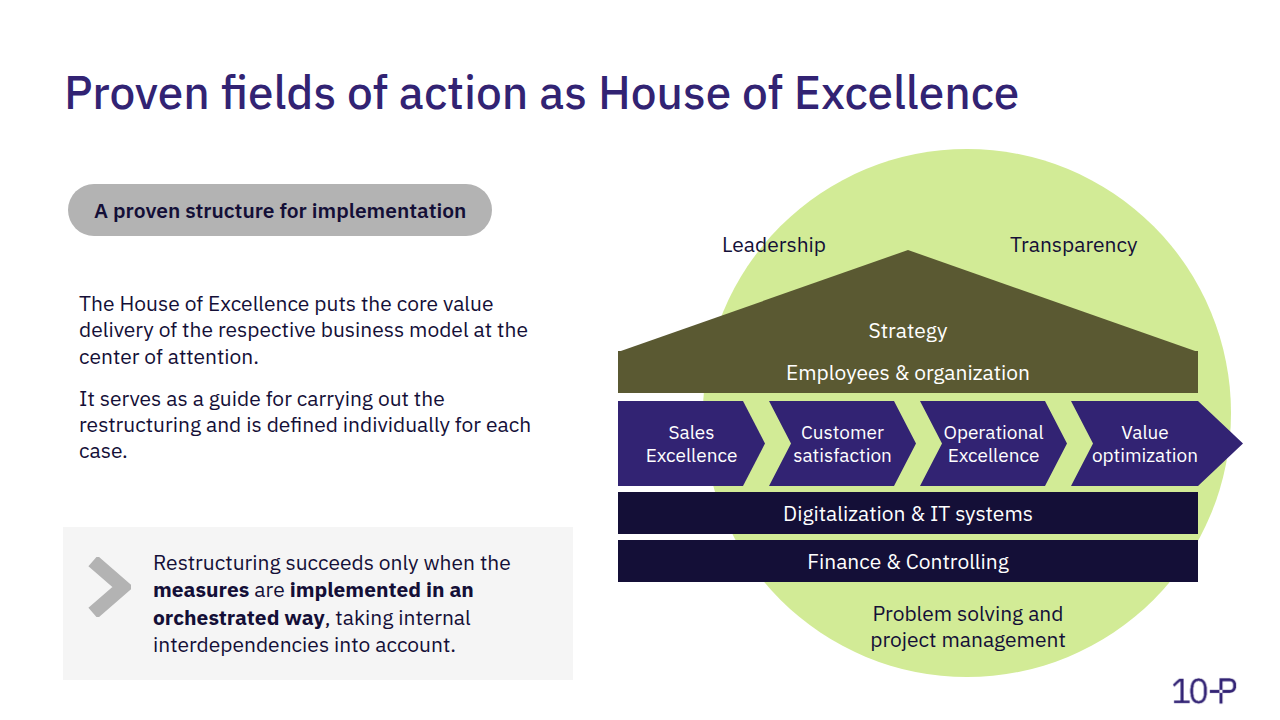
Under the roof of strategy (focus on attractive target industries, clear positioning as a solution provider) and carried by the people & organization layer (clear responsibilities, cultural change, targeted qualification) stood four operational pillars: sales excellence (a modern market presence, active market development, reactivation of existing customers), customer satisfaction (delivery reliability as a binding target, quality standards, supplier management), operational excellence (5S, optimized order processing in the ERP, a new warehouse layout), and value optimization (pricing, working capital, elimination of cost drivers). The foundation was formed by digitalization & IT systems (ERP expansion, master data quality, document management) and finance & controlling (transparency on costs, earnings, and liquidity) – embedded in problem-solving capabilities and project management and flanked by leadership and transparency as overarching brackets.
What matters here is not the list of topics but their orchestration: sustainable peak performance only emerges when the interdependencies between the areas are taken into account. A sales offensive without delivery reliability burns customer trust; digitalization without clean master data automates the chaos.
Step 3: Responsibility into the organization – the hybrid organization
For every action area, a person responsible was appointed from within the company – with a clear goal, their own team, and the necessary decision-making authority. We call this mirroring of the House of Excellence onto the organizational structure a hybrid organization: the best problem solvers work on the most pressing problems without bringing day-to-day business to a standstill. A steering committee defined goals, KPIs, and budgets – numerous individual initiatives were thus managed with owners, deadlines, and measurable progress.
In parallel, we established forward-looking KPI reporting: operational metrics along the value chain, transparent for all employees. Not as an instrument of control but as an instrument of leadership – those who see their own contribution take ownership.
Step 4: Enablement instead of consulting – Institutional Learning
Perhaps the most important difference from traditional consulting: the problem-solving knowledge was not imported and then withdrawn again, but systematically anchored in the organization. With a structured problem-solving methodology in eight steps, targeted training, and a leadership control loop put into daily practice, employees were enabled to identify, assess, and solve problems on their own. We call this Institutional Learning – help for self-help, for value creation that lasts.
The results after three years
The numbers speak for themselves:
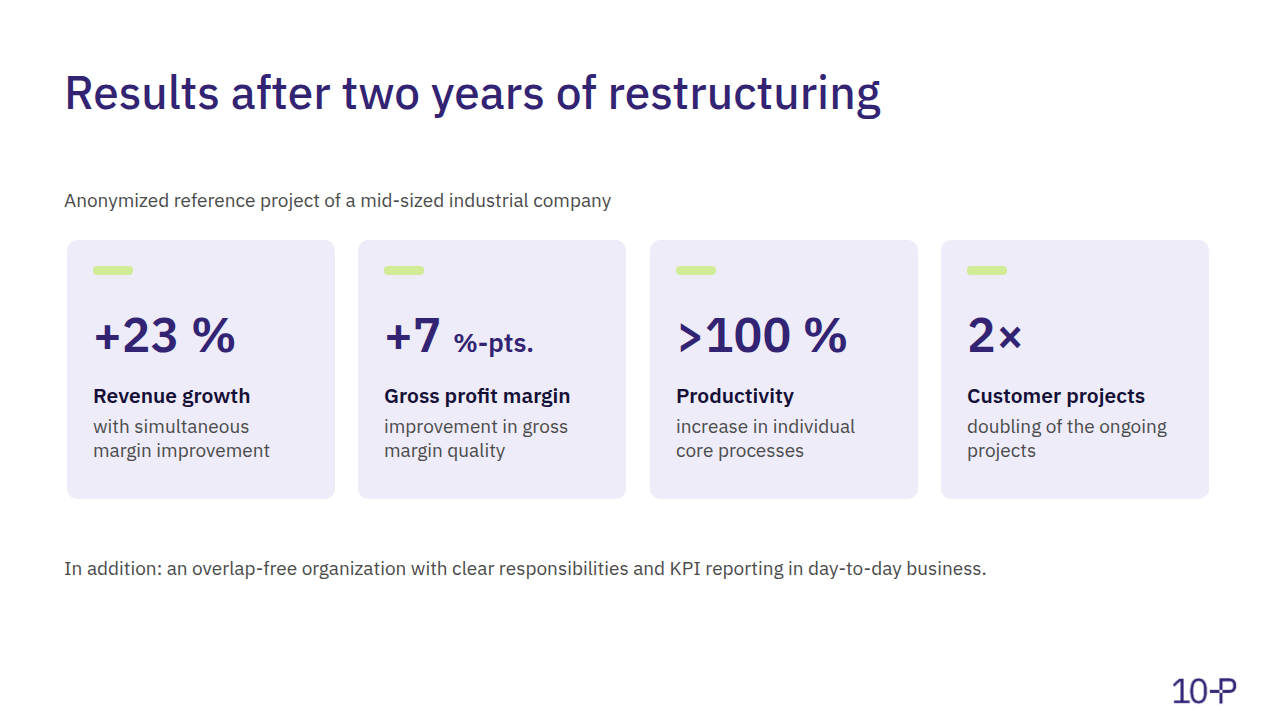
- +23% revenue with an improvement of the gross profit margin by 7 percentage points
- Productivity gains of over 100% in individual core processes through layout optimizations, system support, and new warehouse management
- An overlap-free organization along the value creation processes with clear responsibilities
- Forward-looking KPI reporting for managing day-to-day operations
- An effective sales organization and a doubling of ongoing customer projects
At least as important as the numbers: today the company is able to solve new problems on its own, faster than they arise – and is thus back in the state of optimization. That is precisely the overarching goal of every restructuring.
Three lessons
- Restructuring is a state, not a fate. Those who recognize the typical signs early – declining earnings, a growing backlog of problems, shrinking financing headroom – can act from a position of strength.
- Structure beats frantic activity. It is not the number of measures that decides, but their prioritization and orchestration along a clear structure such as the House of Excellence.
- Only what the organization can do itself is sustainable. The turnaround succeeds for good when leadership structures, transparency, and problem-solving capabilities are anchored in the company – not in the consulting team.
Note: This case study is based on a real mandate of 10-P Consult AG. To protect the client, the name and identifying details have been anonymized or generalized.
Further articles:
Restructuring: overcoming the crisis (link)
Institutional Learning 1 (link)
Building momentum through Institutional Learning (link)
Where does your company stand?
The Corporate Health Check quickly shows where your company stands and which levers have the greatest impact. Let's get to know each other in a no-obligation conversation.
Request a meeting

