CHARACTERISTICS

Made to drawing, priced by negotiation, utilisation as fate

Suppliers manufacture and finish what the customer has drawn and specified. Their earnings are therefore decided in the costing of each individual part, in the utilisation of the equipment and in negotiations with a few large customers.

Every part has its own calculation. Hundreds of part numbers with their own batch sizes, tools and tolerances. Only post-calculation shows whether a part makes money.

Customers negotiate hard. Buyers expect regular price reductions. Without a contractual rule, rising material and energy costs can hardly be passed on.

The equipment has to run. Presses, machining centres and coating and painting lines are expensive. If utilisation falls, every missing percentage point hits the result directly.

Dependent on the customers' pace. Call-offs fluctuate with the customers' production. Those heavily dependent on automotive feel every downturn immediately.

Market situation · As of November 2026

Volume returns more slowly than margin is lost

In Germany, there is still no tailwind. Foundries produced around 4 per cent less in 2025, plastics processors' revenue fell by 1.8 per cent, and both associations expect sideways movement at a low level for 2026. Among manufacturers of motor vehicle parts, the number of employees fell by 7.6 per cent by mid-2026, more than in the automotive industry as a whole. Foreign orders of German car manufacturers from January to September 2026 were 16 per cent below the previous year.

In Switzerland, the tech industry grew in the first half of 2026, driven almost exclusively by large companies; SME revenues fell by 3.8 per cent. Among SME suppliers in the MEM industry, capacity utilisation moved closer to the long-term average again in the second quarter, but around four in ten companies still report falling margins.

More volume alone does not solve the problem. Those who know now which parts and customers cost money and adjust their costs to capacity utilisation gain room for manoeuvre for the next round of price negotiations.

Sources: BDG, annual forecast of January 2026; GKV, press release of 18.02.2026; Destatis, press release of 14.08.2026; VDA, press release of 04.10.2026; Swissmem, press release of 24.08.2026; Swissmechanic, economic barometer of 26.08.2026.

−4%

Foundry production Germany 2025, rounded

−1.8%

Revenue of plastics processing Germany 2025

−7.6%

Employees in motor vehicle parts Germany, mid-2026

−16%

Foreign car orders Germany, Jan.–Sep. 2026

−3.8%

Revenue of Swiss tech SMEs, first half of 2026

4 in 10

Swiss MEM SMEs with falling margins, Q2 2026

Early warning signals

How to recognise that action is needed

A weak quarter can have one-off causes. It becomes critical when patterns repeat. The following structural signals show that the cause lies within the company itself – in structures and processes – long before it becomes visible in the income statement.

  • Auftragsbestand und Abrufe aus Rahmenverträgen sinken. Kunden schöpfen ihre Rahmenverträge nicht aus, und niemand verfolgt den Ausschöpfungsgrad systematisch.
  • Die Auftragsabwicklung ist von häufigen Planänderungen geprägt. Eilaufträge und verschobene Abrufe werfen die Fertigungsplanung laufend um; Rüstaufwand und Liefertermine leiden.
  • There is no post-calculation per part. Nobody knows exactly whether individual parts make money, and loss-making parts keep running.
  • Cost increases stick with the supplier. Price adjustment clauses are missing or not applied.
  • Shift model and staffing are rigid. They do not follow demand when call-offs fall.
  • Disruptions in production are considered normal. Causes of downtime and quality problems are not tackled systematically.
  • Sales waits for enquiries. New customer industries and customers are not approached in a targeted way.
  • Quotations are based on old costing rates. Current actual costs are not taken into account.
Strukturelle Frühwarnsignale in der Fertigungstechnik: Rahmenverträge, Auftragsabwicklung, Kalkulation, Preise, Personal, Fertigung, Vertrieb und Angebote (nicht abschliessend)

The list is not exhaustive. If several signals apply, the cause usually lies in structures and processes, not with individual parts or customers. The Corporate Health Check shows exactly where: an independent assessment across ten dimensions of the company with prioritised fields of action.

More about the Corporate Health Check

Levers

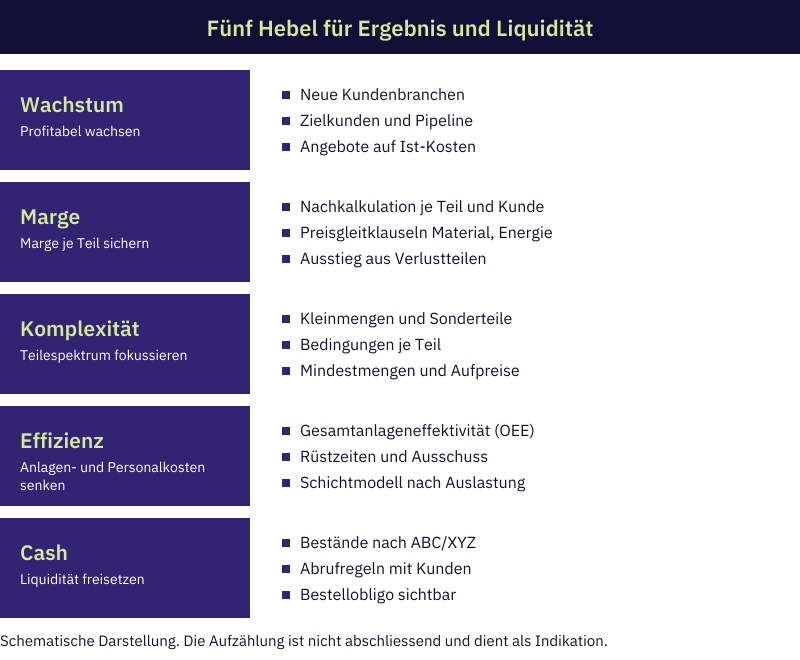
Five levers for earnings and liquidity

Earnings and liquidity rarely depend on a single department. Growth, margin, complexity, efficiency and cash influence each other and should therefore be considered together.

Growth. Identify customer industries in which your own processes and quality level are in demand, actively approach target customers and base quotations on current actual costs. New markets are opened up as part of a transformation.

Margin. Post-calculate every part number and every customer, agree price adjustment clauses for material and energy, and renegotiate or phase out permanently unprofitable parts. These are typical building blocks of an optimisation.

Complexity. Set clear conditions for small quantities and special parts: minimum quantities, surcharges or exit. More on this in the article Peak performance through strategic focus.

Efficiency. Increase overall equipment effectiveness, reduce set-up times and scrap, and adapt the shift model and staffing to actual utilisation. How this succeeds with your own teams is shown by Operational Excellence.

Cash. Manage inventories using ABC/XYZ logic, agree clear call-off rules with customers and make purchase commitments visible. If liquidity is tight, working capital becomes the core of a restructuring.

Fünf Hebel für Ergebnis und Liquidität in der Fertigungstechnik: Wachstum, Marge, Komplexität, Effizienz und Cash mit typischen Ansatzpunkten

KPIS

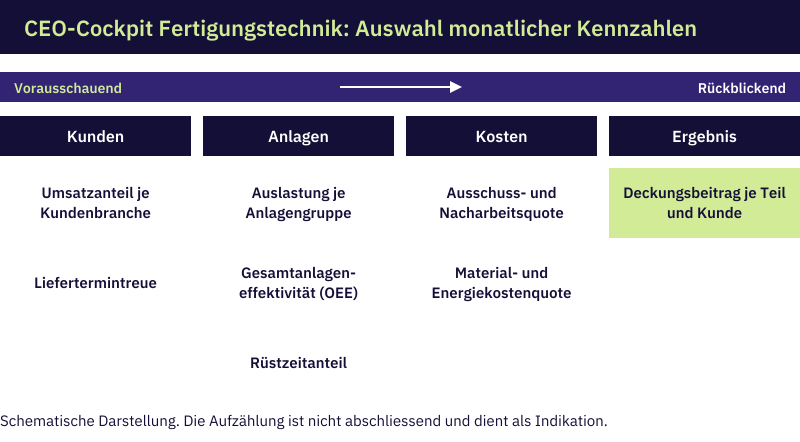
Which KPIs management at suppliers should see every month

The early warning signals show where structures and processes are weak. KPIs measure where the company stands and whether measures are working. A few reliable figures are enough – monthly, comparable and forward-looking.

  • Contribution margin per part number and customer: shows which parts and customers carry the earnings and which consume them.
  • Overall equipment effectiveness (OEE): shows how much of their possible output the machines actually deliver.
  • Utilisation per equipment group: shows early where capacity is lacking or lying idle.
  • Set-up time share: the share of machine time lost to changeovers.
  • Scrap and rework rate: shows where material and time are lost.
  • Material and energy cost ratio: shows whether cost increases are reflected in prices.
  • Revenue share per customer industry: makes dependencies visible.
  • On-time delivery: the share of call-offs delivered on the promised date.
CEO-Cockpit Fertigungstechnik: Auswahl monatlicher Kennzahlen zu Kunden, Anlagen, Kosten und Ergebnis

The selection is not exhaustive; which KPIs fit depends on the business model. In the CEO cockpit, we bring these KPIs together on three levels, from management to the core process.

More about the CEO cockpit

FROM PRACTICE

When the most important customer invites the competition

Fallbeispiel Restrukturierung bei einem Zulieferer von Präzisionskomponenten

Restructuring at a supplier of precision components

A Swiss manufacturer of electromechanical precision components supplies customers in industrial automation and automotive. Due to capacity bottlenecks, it lost its status as sole supplier to its most important customer, and revenue collapsed by a quarter within two years. Transparency about margins and scrap, a reorganised production network and systematic sales took the company from negative EBITDA to positive EBIT in 18 months.

Read the case study
Beitrag: Chronische Verlustbringer

Chronic loss-makers

Almost every company carries a unit that has been losing money for years: a part, a customer, a machine. The article shows how to recognise a chronic loss-maker and why the exit needs an automatic trigger rather than yet another decision.

Read the article

Our key topics

With tailored approaches and proven methods, we support you in aligning and developing your company — independently, and starting from your current economic situation.

Transformation: engineering and office area of an industrial company

Transformation

Sharpen your strategy and develop a holistic alignment to realize growth opportunities.

Learn more
Optimization: production area with assembly workstations and material flow

Optimization

Increase your problem-solving capacity and develop your organization from mediocrity to peak performance.

Learn more
Restructuring: production hall with machinery and operator workstations

Restructuring

Secure your company's viability through structural interventions and sustainable earnings optimization.

Learn more
Turnaround: production area of an industrial company with machinery and employees in motion

Turnaround

Secure your company's liquidity and continued existence and restore its earning power for the long term.

Learn more

EXPERIENCE

Management and hands-on experience from industry

Our team combines management experience with technical, hands-on experience from industry. We know manufacturing companies not only from analyses but also from being responsible for results, employees and customers. That is why we speak the same language as your management and your production, and our solutions work in everyday operations.

More about us

FREQUENTLY ASKED QUESTIONS

Frequently asked questions about consulting for suppliers

Which suppliers does 10-P Consult work for?

For suppliers in forming, casting, injection moulding, turned parts, machining as well as surface technology, coating and painting with around 30 to 500 employees in German-speaking Switzerland and southern Germany. Typical customers are mechanical and plant engineering, the automotive industry and medical technology.

How do you deal with customers' price demands?

With figures instead of gut feeling. We make the contribution margin per part and customer visible, create rules for material and energy costs and prepare price negotiations with robust calculations. Parts that permanently make no money are renegotiated or phased out.

We depend heavily on the automotive industry. What should we do?

First secure the situation: adjust costs to utilisation and clean up loss-making parts. In parallel, we examine in which other industries your processes and quality certifications are in demand and build up sales there in a targeted way.

Is it worth investing in new equipment?

That depends on utilisation, part spectrum and customer loyalty. The largest reserves often lie first in set-up times, scrap and planning of the existing equipment. Investments pay off once it is clear where the bottleneck is.

What if the situation is already critical?

Then securing liquidity takes priority. On request, we take over interim management or the role of Chief Restructuring Officer as part of a consulting mandate.

More about turnaround

How does a collaboration begin?

With an assessment of where you stand. The Quick Health Check takes five minutes to complete and shows what state your company is in and which fields of action offer the greatest leverage – as a five-page profile, reviewed by an experienced consultant and free of charge.

ASSESSMENT

Where does your company stand?

The Quick Health Check takes five minutes to complete and shows what state your company is in and which fields of action offer the greatest leverage – as a five-page profile, reviewed by an experienced consultant and free of charge.