The Four States of a Company: Where Does Yours Stand?
Every company draws up a balance sheet once a year. It shows what is there: assets, liabilities, equity. What it does not show is the question that decides the coming years: Is the company solving its problems faster than new ones arise – or more slowly?
This is exactly where the 10-P Consult state model comes in. It distinguishes four states – transformation, optimization, restructuring and turnaround – and it is the first assessment we make in every engagement. Not because labels matter, but because each state calls for a different approach. Anyone who tackles a restructuring like an optimization loses time they do not have. Anyone who treats an optimization like a turnaround destroys substance they still need.
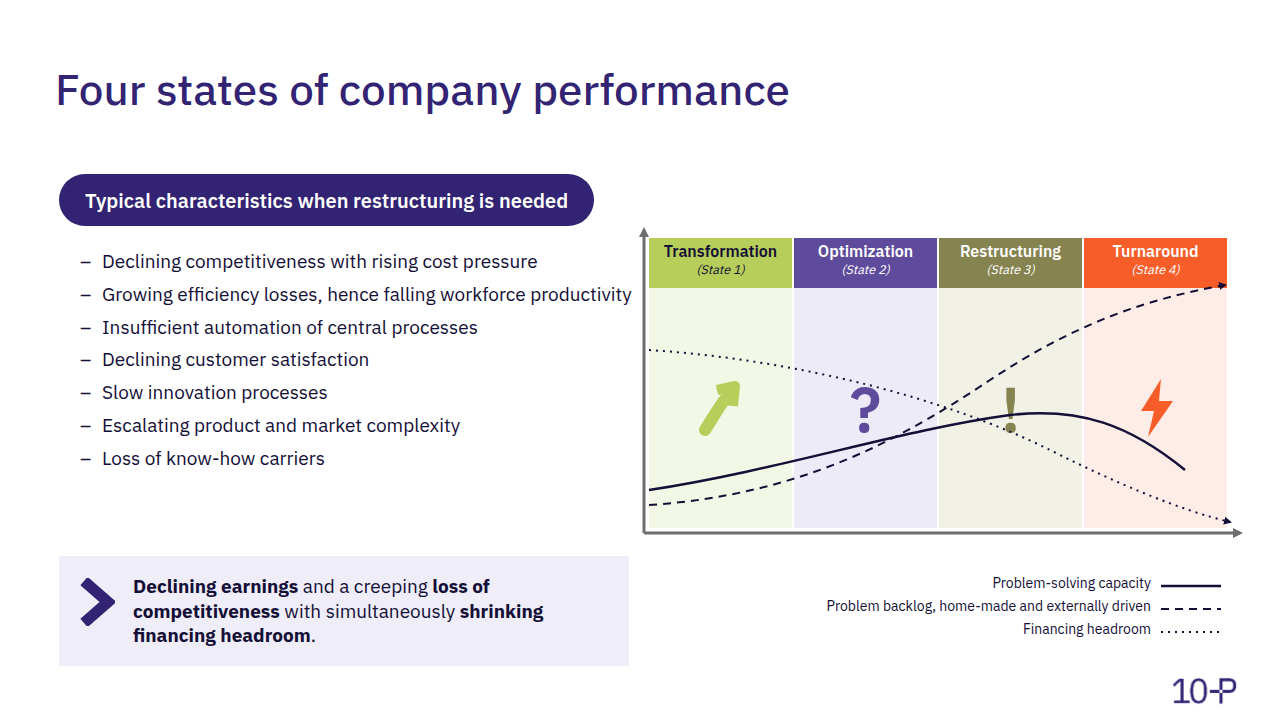
The basic principle: backlog of problems versus problem-solving capacity
Every company carries a backlog of problems. Part of it is homemade: inefficient processes, products that are losing competitiveness, unclear responsibilities. Another part is imposed from outside: tariffs, currency shifts, new regulations, a competitor with the better product. Set against this is the problem-solving capacity – the organization’s ability to identify problems, prioritize them and solve them sustainably. And alongside both sits the stock of opportunities: new markets, new technologies, new customers that only those with spare capacity can seize.
The ratio between these quantities determines a company’s state. And because customer requirements keep rising, price headroom keeps narrowing and the world keeps getting faster, the backlog of problems grows on its own. Problem-solving capacity does not grow on its own – it has to be built.
State 1: Transformation
Problem-solving capacity clearly exceeds the backlog of problems. The company solves existing and newly emerging problems as part of day-to-day business and can focus primarily on seizing opportunities. Typical examples are companies at the forefront of a technology or a trend that operate predominantly opportunity-driven.
The core task: keeping pace with technology and market developments and continuously adapting the business model. The uncomfortable property: transformation is not a state you reach once and then keep. It has to be earned anew every year – a technology disruption or a new competitor is enough, and the company slips into optimization.
State 2: Optimization
The company just about copes with the problems that arise. The figures are decent, often even good – but there is significantly less room left for seizing opportunities. The first signals appear at the customer front: delivery dates that are no longer met, rising complaints, a price-performance ratio that is shifting in favor of the competition.
The core task: selectively realigning the company – from a position of strength and with the aim of returning to transformation. The uncomfortable property: the pressure to act is low. With return on sales still in double digits, flying blind operationally goes unnoticed for a long time. How a special machinery manufacturer tackled this state on its own is shown in our optimization case study.
State 3: Restructuring
The backlog of problems exceeds problem-solving capacity. Put simply: things no longer work. Customers complain, processes run inefficiently and with errors, competitors eat away at the margin, the innovation pipeline is thin. The problem congestion is now also visible in the annual results.
The core task: systematically capturing and prioritizing the backlog of problems and strengthening the performance processes – with clear responsibilities and maximum transparency. The uncomfortable property: the cause almost always lies within the organization itself – in responsibilities that have not been clarified or are not lived. We have described our approach in detail in the article “Restructuring: Mastering the Crisis”; what it looks like in practice is shown in the case studies of a mid-sized industrial company and a global component manufacturer.
State 4: Turnaround
Losses build up, revenue declines, customers walk away, liquidity is strained to critical. Lenders massively restrict the room for maneuver. The company is no longer master of its own house – unless the owner provides the required liquidity themselves.
The core task: secure liquidity first, then focus the business model. The uncomfortable property: time is pressing. Whoever only cuts costs cuts themselves to death; whoever only invests runs out of money. In this state, additional external capacity is advisable, because a cash drain does not allow for long learning curves. How a power tool manufacturer initiated its transformation after the end of patent protection is shown in our turnaround case study.
The dangerous transitions
The insidious thing about the model: nobody holds up a mirror and tells you that you are sliding into the next state right now. The transitions are gradual, and their significance is often recognized only when it is late. Two transitions deserve particular attention:
- From optimization to restructuring. The income statement is the last to react. Anyone who waits for the annual accounts recognizes the transition with a delay. Visible earlier are delivery reliability, complaint rates, the development of contribution margins and new customer acquisition.
- From restructuring to turnaround. Between the two states lies the financing headroom. As long as it exists, the company can act under its own steam. Once it is used up, others have a say. Anyone who tries to sit out a restructuring gambles away precisely this headroom.
The way back is possible, but as a rule it leads step by step. Both companies from our restructuring case studies are back in the state of optimization today – a realistic interim goal that keeps the path to transformation open.
How to assess your company: the problem-opportunity balance sheet
Just as you prepare a balance sheet and an income statement every year, we recommend drawing up a problem-opportunity balance sheet once a year: What backlog of problems exists today, how has it developed over the last three to five years – and what problem-solving capacity is there to set against it? Four questions are enough for an initial assessment:
- How many fields of action exceed your own problem-solving capacity today? This means topics that have been on the list for months without anyone taking responsibility for solving them.
- How have your contribution margins developed over the last five years? Not revenue and not the annual result – contribution margins by product group show earlier whether price and performance still match.
- How many new customers have you won in the last twelve months? A company that only lives off its existing customers is using up its future.
- How large is your financing headroom? It decides whether you can act under your own steam – or whether others have a say.
Anyone who answers these questions honestly usually knows quite precisely where their company stands. For a robust diagnosis, we use the Corporate Health Check: around 135 questions along the ten dimensions of the 10-P model, rated by maturity level and condensed into a state assessment with prioritized fields of action.
Conclusion
The state model is not a verdict on a company but a determination of where it stands. Hardly any long-established company has not been through a restructuring at some point – it is part of entrepreneurial life. What matters is recognizing your own state early and honestly and aligning your approach accordingly. And what matters is that problem-solving capacity grows with every problem solved – within your own organization, not with the consultant. That is the core of Institutional Learning.
Would you like to know which state your company is in? In a no-obligation 30-minute conversation, we jointly assess where your company stands and which fields of action offer the greatest leverage. Book a conversation.
Further articles:
Restructuring: Mastering the Crisis (link)
Optimization Case Study: When Technology Leadership Is No Longer Enough (link)
Turnaround Case Study: When the Flagship Product Becomes a Risk (link)
Restructuring Case Study: From Crisis to Peak Performance (link)
Where does your company stand?
The Corporate Health Check quickly shows where your company stands and which levers have the greatest impact. Let's get to know each other in a no-obligation conversation.
Request a meeting

