
Optimization Case Study: When Technology Leadership Is No Longer Enough
How a globally positioned special-purpose machine builder recognized, at the height of its success, the limits of its proven foundation – and set the course for the future with six building blocks, under its own power.
The starting position in 30 seconds
Situation. A company that has been active in special-purpose machine building for over 60 years and is specialized in a highly specific joining technology for plastics, cardboard, and metals. On this technology base it serves three business units, each with dedicated customer groups. The track record is impressive: since 2000, revenue has quadrupled to around EUR 130 million, the company has a global footprint with 20 locations, and the return on sales was in double digits for many years.
Complication. Technology leadership has driven great success with customers for years – but on a foundation that is increasingly reaching its limits. The core technology has seen no notable innovation for around 20 years, innovation management is not professionalized, and project management is inadequately set up. There is a lack of transparency about the state of internal processes, which makes targeted management possible only to a very limited extent. Responsibilities are not clearly anchored in the organization, which makes delegating tasks and measuring individual target achievement difficult. Operationally, these structural weaknesses show up in high complaint rates and poor delivery reliability, increasingly jeopardizing customer satisfaction. Added to this is an IT infrastructure that no longer matches a globally positioned company of this size. The consequence: earnings power has weakened considerably over the past three years – with a clear trend toward single digits.
Solution. Instead of hoping that the economic and geopolitical situation would improve again, the managing partner decided to act: a critical diagnosis along the 10-P model – developed by the company itself and condensed in full-day workshops in the smallest circle. The result is a transformation program with six building blocks, carried by the company's own teams.
This is the phase we call optimization: the company is doing well – no crisis in sight. It is about fixing weaknesses from a position of strength, before they turn into crises. Its uncomfortable characteristic: the level of pain is low – with return on sales still in double digits, flying blind operationally goes unnoticed for a long time.
The diagnosis: successful, but flying blind
In the workshops, all essential aspects of holistic corporate management were critically examined along the 10-P diagnostic model. We started with the strategy of the three business units: clear positioning as performance leader, carried by a superior technology and an outstanding advisory service that solves customers' application problems quickly and efficiently. Here: no need for action.
But already with the second P – the products – the need for action became visible. Today's economic success is still carried by a technology that has seen no notable innovation in a good 20 years: neither in ease of use nor in intelligent data processing for documenting the processes. Competitors have recognized the weakness and have moved ahead in some aspects – with the effect that the price-performance ratio in the market has tended to shift in favor of the competition.
Sales delivered further findings, voiced with growing urgency: firmly promised delivery dates were met in only 60 % of cases – and that with inventories of parts and assemblies covering more than 250 days. On top of that, quality issues around warranty and goodwill that are becoming a burden in sales conversations.
When we asked for figures, data, and facts on these topics: radio silence. Outside classic financial accounting, the company has virtually no metrics on the performance of its core processes. In a word: operationally, the company is flying blind. Which was all perfectly fine at double-digit return on sales. But not anymore.
The alarming reports from sales inevitably led to the question of the organization: are responsibility, decision-making authority, and measurability in sync? And sure enough: outside the tightly run sales organization there are no or only very unclear responsibilities for the classic performance parameters. Nobody in the company is truly responsible for delivery reliability, product competitiveness, or quality. Then no one should be surprised by inadequate performance.
The transformation program: six building blocks
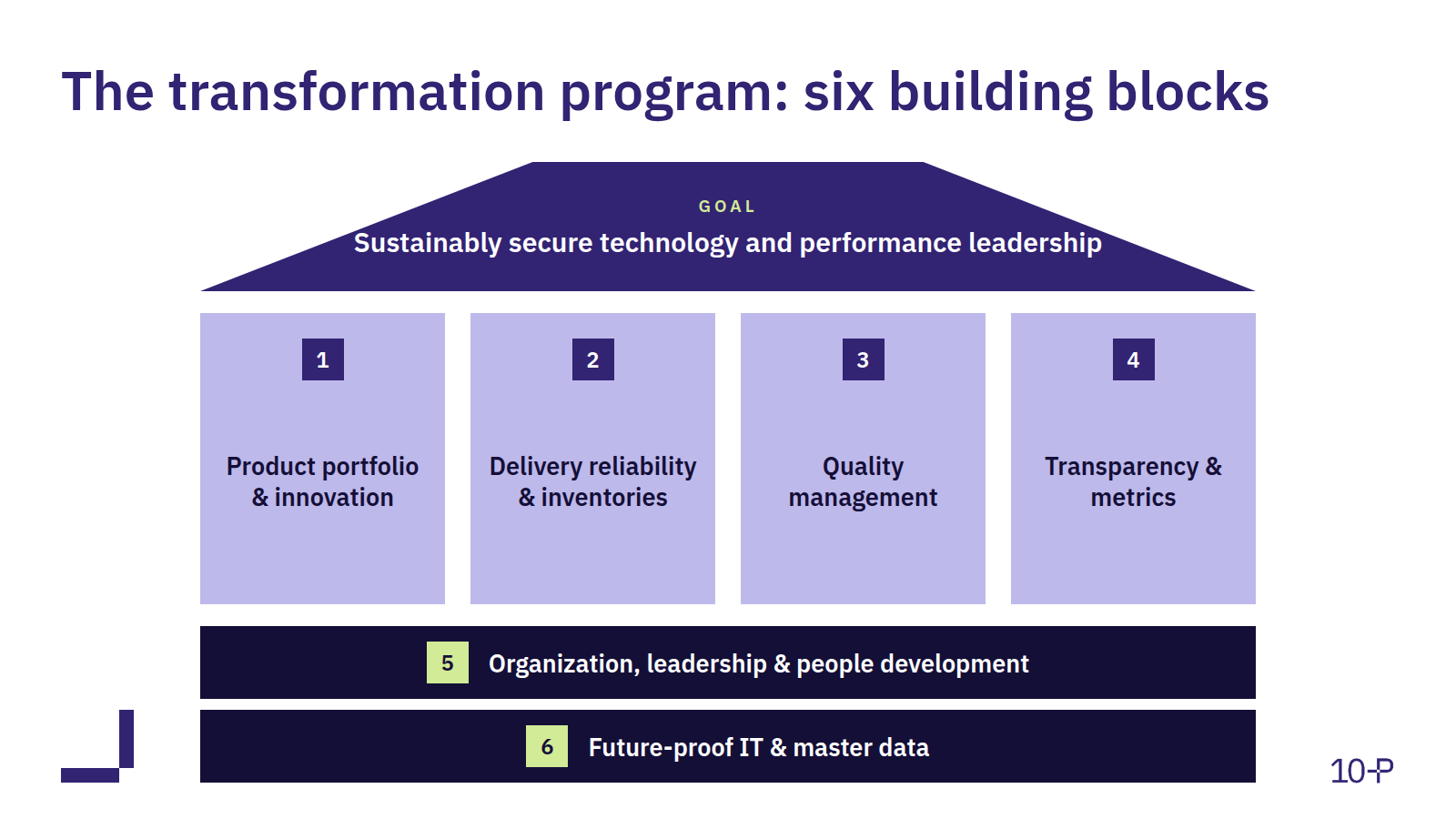
After just a few workshop days, the transformation program was set – six building blocks, summarized in a “House of Excellence”:
- Product portfolio & innovation: revision of the product portfolio in light of changing market requirements; professionalization of innovation management.
- Delivery reliability & inventories: increasing delivery reliability and availability – while reducing inventories at the same time.
- Quality management: eliminating the quality, warranty, and goodwill issues that burden customer satisfaction and sales conversations.
- Transparency & metrics: creating transparency about the performance of all essential processes – by time, quality, cost, and productivity.
- Organization & leadership: revising the organizational structure to anchor clear responsibilities – complemented by leadership as well as internal and external people development, after it became visible that the newly created functions must be filled with qualified people.
- IT & master data: taking stock from the security and performance of the hardware to the availability and maintenance of master data – with the goal of turning IT into a strategic competitive advantage.
Implementation: own teams instead of an army of consultants
For each building block, owners and project teams from within the company were appointed. Where in-house expertise is lacking, external Learning Agents were defined who take the employees by the hand and develop learning experiences together – teaching the teams how to solve complex problems on their own in the future. A tight schedule with steering committee meetings every four to six weeks keeps the program on track.
The decisive difference from classic consulting: instead of bringing in a team of consultants, the company was enabled to produce a profound diagnosis of its own weaknesses – the first step in learning – and to set the right priorities. Had external consultants been “put in charge” of the employees, it would have weighed on the motivation of everyone involved. This way, they hold their project in their own hands.
The impact after twelve months
The transformation program has now been running for twelve months, and it is fascinating to see how the individual teams are developing. There are teams that have made remarkable progress, and teams whose results are not yet satisfactory – partly a matter of qualification and motivation, partly of framework conditions. This is something the steering committee must always weigh carefully.
One thing is already clear: because the transformation is carried largely by the company's own employees, management can see which leaders have real problem-solving skills – and who is ready for further responsibilities. With an external consulting team, this insight would be almost impossible to gain – quite apart from the learning experiences the teams have already gathered. This is where lasting value is created.
Three key takeaways
- The most dangerous weakness is the one that success conceals. With return on sales still in double digits, flying blind operationally goes unnoticed for a long time. The need for action shows first at the customer front – delivery reliability, complaints, price-performance positioning – and only much later in the income statement.
- Optimization starts with transparency. Without metrics on the performance of the core processes there is no targeted management, no effective delegation, and no measurability. Anchoring responsibility requires measures first.
- Whoever makes the diagnosis themselves also carries the implementation themselves. Own teams with targeted support from Learning Agents are more motivated than any army of consultants – and along the way, management discovers which leaders will take the company forward.
Is your company facing similar challenges? The Quick Health Check shows in five minutes which state your company is in and which fields of action offer the greatest leverage – as a five-page profile, reviewed by an experienced consultant and free of charge. Start the Quick Health Check.
Note: This case study is based on a real 10-P Consult engagement. The client's name and identifying details have been anonymized or generalized.
Further articles:
Restructuring Case Study: From Crisis to Peak Performance (link)
Turnaround Case Study: When the Flagship Product Becomes a Risk (link)
Peak Performance through Transparency (Part 1 / 2) (link)
Where does your company stand?
The Quick Health Check places your company in our state model in five minutes – as a five-page profile, reviewed by an experienced consultant and free of charge.
Start the Quick Health Check

