Turnaround Case Study: When the Flagship Product Becomes a Risk
How a long-established power tool manufacturer set its turnaround in motion after patent protection expired: through strategic focus, the resolution of a years-long investment backlog, and a socially responsible workforce transition.
The starting position in 30 seconds
Situation. A power tool manufacturer with a history of almost 150 years, globally positioned with around EUR 200 million in revenue and 15 locations worldwide. Roughly four decades ago, the company achieved a patent-protected breakthrough innovation for metalworking applications. For more than 30 years, this single product carried the company: reliable, profitable, seemingly untouchable.
Complication. The company never seriously prepared for the foreseeable end of its patent protection. When it came, every major competitor offered comparable products at significantly lower prices. The decades of privileged market position turned out to be a liability: no clear strategic direction combined with sprawling product complexity, no visible development programs to compensate for declining revenues with new products, no KPIs to assess process performance, and an IT infrastructure that was not fit for the future. The sales force was set up as a distribution organization: for decades it never had to sell, only to allocate. On the personnel side, 42% of employees had been with the company for more than 15 years and 30% were over 60; personnel costs stood at well over 60% of value added, and long-grown structures created strong institutional inertia. By this point, financial reserves had shrunk considerably; necessary investments in the future could no longer be funded from ongoing operations.
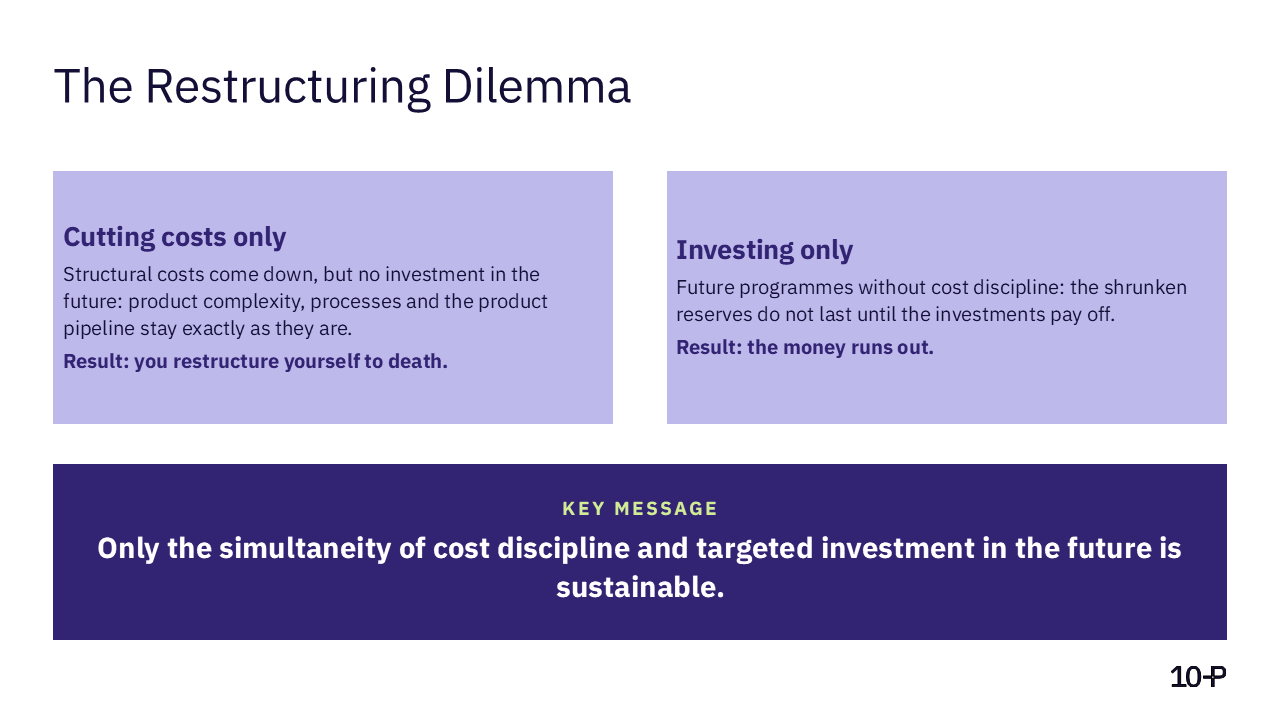
This is the phase we call a turnaround: it is no longer about optimization, but about the company's survival. And it has an uncomfortable property: cut costs alone and you save yourself to death; invest alone and you run out of money.
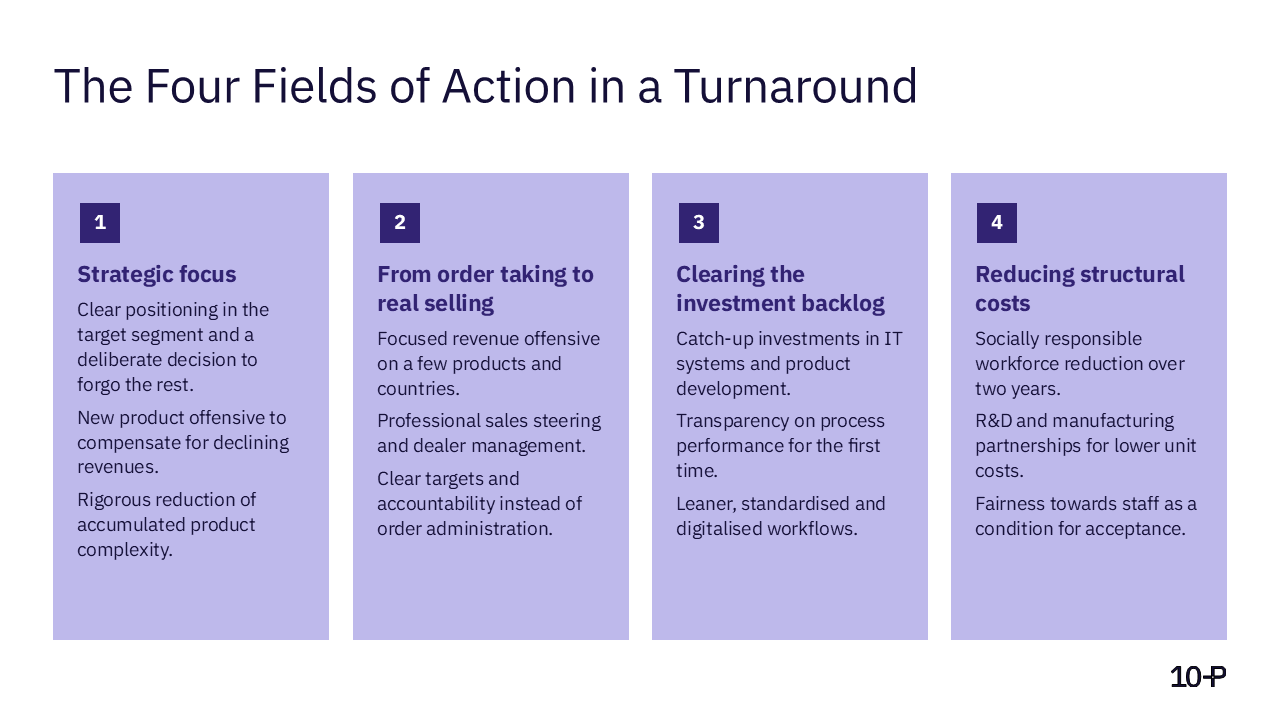
Solution. Not an across-the-board austerity program, but the simultaneous renewal of strategy, market approach, processes, and cost structure. A turnaround understood as the realization of opportunities, carried by four fields of action.
Field of action 1: Strategic focus instead of grown complexity
The starting point was sharpening the strategic positioning: which market segment does the company concentrate on, and what does it deliberately leave aside? From this focus, a new product offensive was derived, investing purposefully for the first time in years in compensating for eroding revenues. In parallel, the product complexity that had sprawled over decades was consistently reduced, because every variant nobody needs ties up capacity the future depends on.
Field of action 2: From allocation to selling
An organization that spent 30 years allocating a product without competition unlearns how to sell. A focused revenue offensive was therefore launched, deliberately concentrated on a few products and a few countries, to stop the negative trend where the leverage is greatest. At the same time, sales management and dealer support were professionalized and the leadership of the sales force was tightened: clear targets, clear responsibility, active market development instead of order administration.
Field of action 3: Resolving the investment backlog
Investments in IT systems and product development that had been postponed for years were deliberately caught up on. The renewed IT systems create transparency about process performance for the first time. This is the basis for recognizing problems before they show up in the results. Building on this, internal processes were streamlined, standardized, and digitalized; today, first AI applications support procurement, accounting, and product management.
Field of action 4: Reducing structural costs, socially responsible and partnership-based
With personnel costs at over 60% of value added, there was no way around a workforce transition. What mattered was the how: a socially responsible reduction reaches the required workforce size over two years, plannable for the company, fair to long-serving employees, and without destroying the trust of the remaining workforce. In addition, a close development and manufacturing cooperation was established with a Chinese company in the industry, lowering unit costs and accelerating development processes. It provides access to competitive cost structures without giving up the company's own product expertise.
Where the company stands today
The turnaround is not a closed chapter, but the structural course has been set: the investment backlog in IT and product development has been resolved, process performance is measurable for the first time, product complexity is falling, the sales force is actively led instead of administered, the workforce transition is on track, and the cooperation gives the company competitive unit costs and shorter development cycles. Above all, the company once again has a clear answer to the question of what it wants to stand for in the market. That is the precondition for getting out of the defensive and back into the game.
Three lessons
- The crisis begins in success. The end of patent protection is not a stroke of fate; it is a date in the calendar. Companies that use the years of privileged market position to develop their strategy, product pipeline, and processes never need a turnaround.
- A turnaround is not just about cutting costs. Cutting costs alone destroys future viability; leaving the investment backlog untouched fights symptoms. The only sustainable path is the simultaneity of cost discipline and targeted investments in the future.
- Institutional inertia cannot be commanded away. In tradition-shaped organizations, the how of the transformation decides its success: transparency about the situation, a socially responsible path, and clear responsibilities create the acceptance without which no turnaround succeeds.
Is your company facing similar challenges? In a no-obligation initial conversation, we jointly assess which phase your company is in and which fields of action offer the greatest leverage. Get in touch.
Note: This case study is based on a real 10-P Consult engagement. The client's name and identifying details have been anonymized or generalized.
Further articles:
Restructuring: overcoming the crisis (link)
Restructuring Case Study: From Crisis to Peak Performance (link)
Where does your company stand?
The Quick Health Check places your company in our state model in five minutes – as a five-page profile, reviewed by an experienced consultant and free of charge.
Start the Quick Health Check

