
Restructuring: Mastering the Crisis
No one should say: that can never happen to me as the head of my company! Unfortunately, it can happen to anyone – which is why it is worth taking a holistic look at the topic of restructuring.
Implemented correctly, a restructuring can represent a great opportunity for a company. The success stories of numerous long-standing hidden champions repeatedly feature phases in which it was crucial to face changed conditions through restructuring and to make the company stronger and more focused through appropriate measures.
How can it come to this in the first place?
Put generically, a company must manage to solve more problems over time than new problems arise. These can be homemade problems such as inefficient processes or products that are no longer competitive, as well as externally imposed problems that are carried into the company from outside. Whether it is additional tariffs, currency shifts, or new regulations: they all represent problems for corporate management and consequently must be solved.
Sounds trivial, but it is not. Because customers' demands on companies' performance are constantly rising while, at the same time, competitive intensity is increasing due to aggressive competitors. This shrinks pricing latitude, which must be offset by continuous efficiency gains. Those who cannot keep up the pace sooner or later fall into the trap that the available problem-solving capacity can no longer keep up with the growth of the backlog of problems.
Often, however, it is precisely externally imposed problems that confront companies with particular challenges that not all are equal to. Just think of the COVID crisis, in which entire business models became obsolete at short notice. Many companies, especially in retail and services, have not recovered from this shock to this day.
In general, it can be observed: the world is becoming ever faster-moving, shorter-cycled, and more complex, which means the backlog of problems – but also the reservoir of opportunities – is constantly growing. If problem-solving capacity does not grow with it, it can very quickly be too late, and the company slides into an existential crisis.
We distinguish 4 phases:
In the phase of transformation, problem-solving capacity clearly exceeds the backlog of problems. The company is able to solve existing and newly emerging problems and can focus primarily on seizing opportunities. These are frequently the highly innovative high-flyer companies that stand at the forefront of a technology development or a trend and operate predominantly opportunity-driven. Transformation here means: keeping pace with technology and trend developments, not losing touch, and not missing important developments around the business model. Adapting to changing conditions through permanent transformation – that is what matters.
Now, despite all efforts, it can happen that the transformation momentum weakens, technology disruptions occur, new competitors enter the market, or new regulations hamper the business model – and the company very quickly slips into the phase of optimization. In this phase, the company just about copes with the problems that arise, but there is significantly less room left for seizing opportunities. Optimization is primarily about selectively realigning the company in order to advance back into the phase of transformation.
If it does not succeed in optimizing sustainably, or even in advancing back into the phase of transformation, then a slide into restructuring is inevitable. Now the backlog of problems suddenly exceeds the available problem-solving capacity. Put simply: things no longer work. Customers complain, processes run inefficiently and with errors, competitive pressure eats away at margins, the innovation pipeline is thin, and development processes are also too sluggish. If bureaucratic obstacles are then added, along with wage settlements that lie beyond economic reason, then as a rule the conditions for a restructuring are set. The problem congestion is unmistakable and is also clearly reflected in the development of annual results.
Anyone who believes they can sit out the difficulties with a company that, by our definition, is in the restructuring phase, bears the risk of also slipping very quickly into the phase of turnaround. Losses build up, revenue declines, customers walk away, the liquidity situation is strained to highly critical, so that the company's own room for maneuver is massively restricted by its lenders. A phase I would not wish on any entrepreneur, because they are then truly no longer master of their own house – unless they provide the required liquidity themselves.
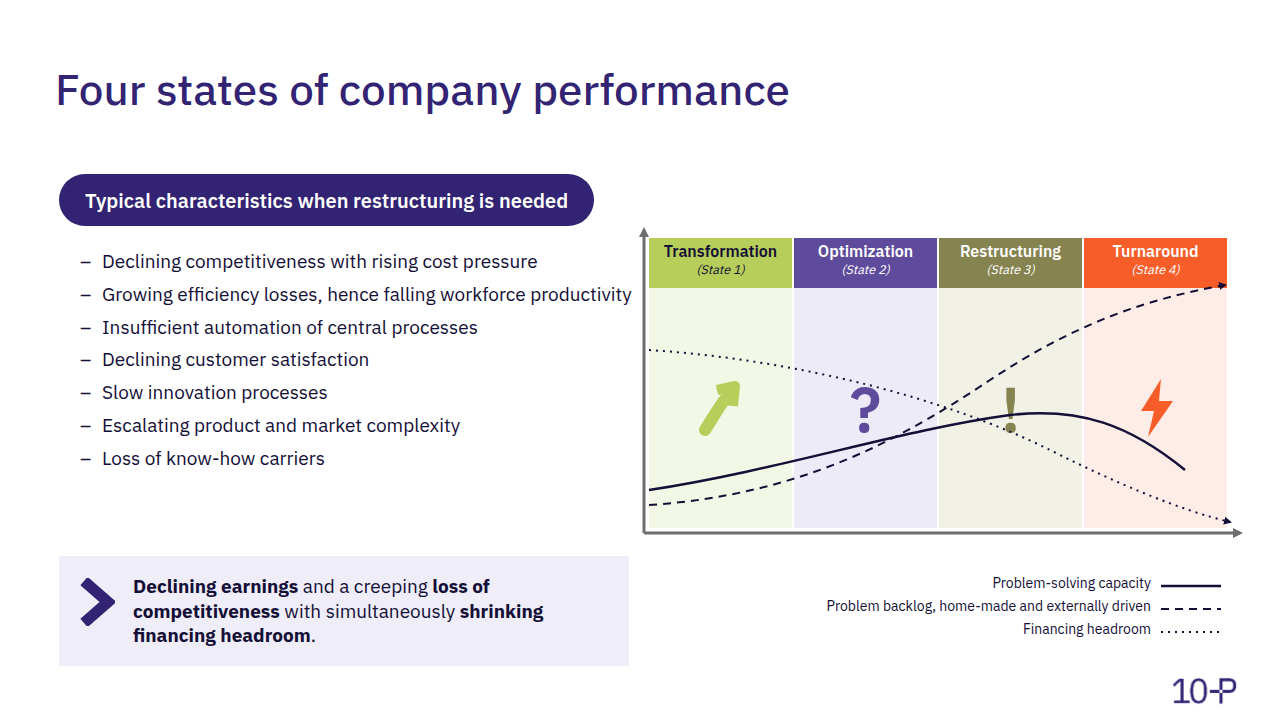
The insidious thing about the progression through the 4 phases: there is no one holding up a mirror and saying: right now we are racing at full throttle into the next stage. It is a creeping process whose full scope is often only grasped when it is already very late, if not too late. This applies in particular to the transitions from optimization to restructuring and later to turnaround.
Just as it is mandatory to prepare a balance sheet together with a P&L statement at least once a year, I recommend that all entrepreneurs and managing directors draw up a problem/opportunity balance sheet once a year, and on this occasion consciously determine what backlog of problems your company holds today and how it has developed over the past 3 – 5 years. Compare this backlog with the problem-solving capacity available in the company, and you will know which phase your company is in.
Restructuring
In this paper, we want to deal exclusively with restructurings. That is, the phase in which the backlog of problems already clearly exceeds solving capacity. Usually accompanied by a marked decline in results over recent years.
Hence the question: how do we escape this "uncomfortable" phase again and ensure that we do not even become a turnaround case?
The approach described below has proven itself here:
1. Capturing and prioritizing the backlog of problems and opportunities
We start with the problem/opportunity balance sheet already mentioned. This balance sheet includes all the truly relevant action areas that are meant to help lead the company back out of restructuring. So it is not only about identified problems; opportunities must also be addressed that can help in the short and medium term to bring about a fundamental trend reversal for the company as a whole.
This list is the basis for an initial assessment: which of the named action areas has what positive or negative impact on the company's development, and what expenditure of time and money is associated with this action area? At this point, management is called upon to estimate the economic effects of the individual action areas in monetary terms. Unfortunately, many teams struggle with this because no one wants to make a mistake. All I can say is: you have to dare to name a figure in euros to the best of your knowledge and belief, because only then will the exercise produce a meaningful portfolio at the end that provides an initial indication of how to prioritize the individual action areas.
Large positive impact with relatively manageable effort – these are the famous "quick wins"; the opposite: action areas with high effort but modest benefit, which certainly have to be set aside for the time being.
2. The House of Excellence
Once the list of assessed action areas is in place, we usually transfer it into a so-called "House of Excellence". Not an analytical tool, but a communication aid to give all stakeholders, in a single picture embedded in the existing business model, a quick overview of what must be worked on at full speed in order to leave the restructuring phase as quickly as possible.
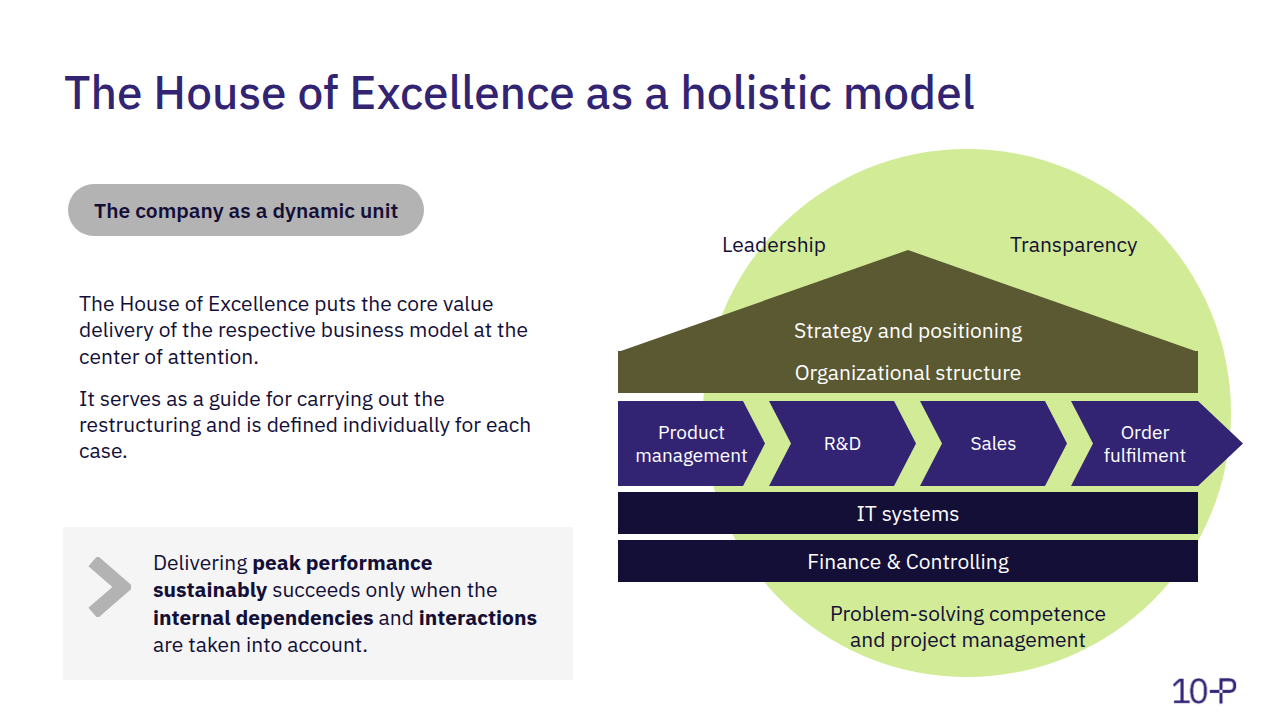
The focus at the beginning of the restructuring is clearly on strengthening the performance processes to improve operating results, and not on strategic questions. Unless the operational measures would make no sense at all without a realignment of the strategy, or because the existing business model is fundamentally in question due to profound upheavals in the market environment. In our experience, however, that is rarely the case.
What do we mean by "strengthening the performance processes"? Starting with topics such as delivery reliability, delivery capability in general, development lead times, the match between development projects and the requirements of target customers, automation of administrative processes, and the provision of essential information for steering the company, to name just a few key ones.
It is about answering the question: what do we need to do significantly better in the future so that we can leave the restructuring phase again as quickly as possible?
3. Linking the House of Excellence with the formal organizational structure
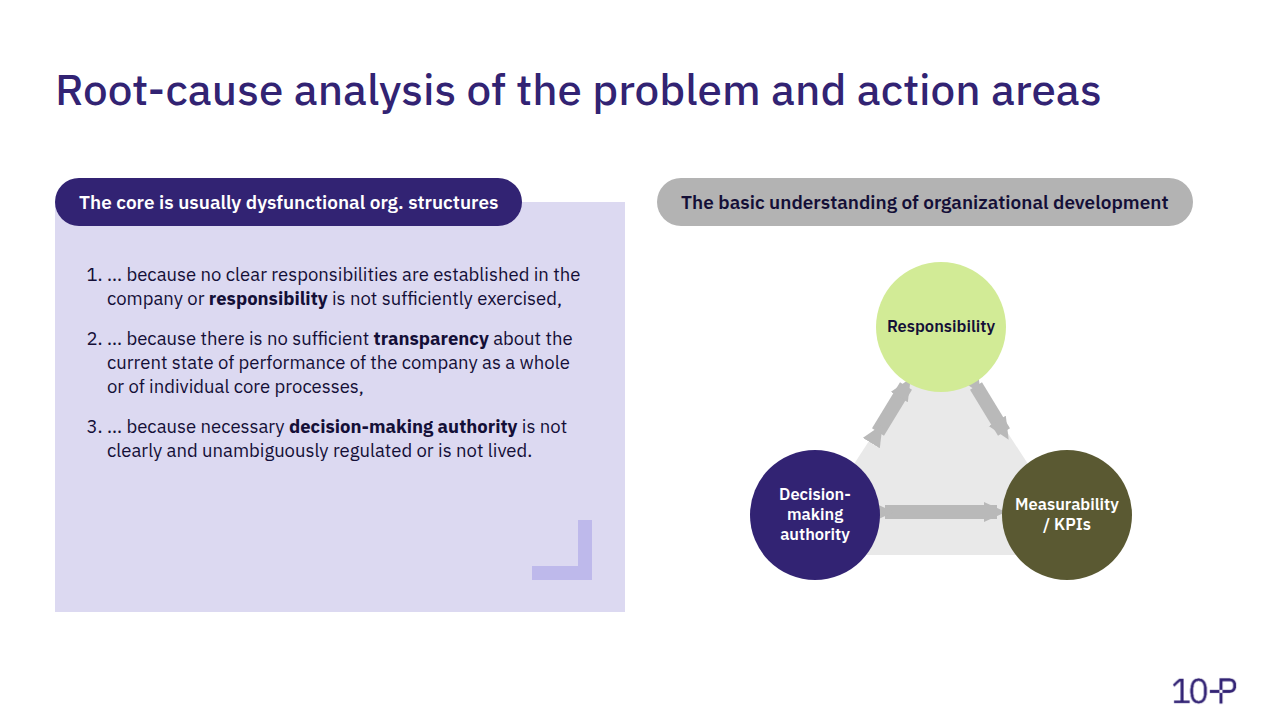
If your company has slipped into the restructuring phase over the years, then in our experience this is almost 100% due to responsibilities not being clearly defined, or the defined responsibilities not being lived.
In our culture, it is unfortunately no longer a given that employees to whom responsibility is assigned actually accept that responsibility and are aware of their personal accountability! And unfortunately, this increasingly applies not only to rank-and-file employees, but all the way up to the highest levels. Just ask the ranks and titles to explain to you what they are responsible for in their company! Titles are listed, job descriptions are pulled out, but concretely articulating their own responsibilities is enormously difficult for many leaders. This is not an accusation against these employees. As a rule, top management simply failed to ensure that clear and unambiguous responsibilities were assigned to individual people. It is easier to hide behind job descriptions and nice-sounding but meaningless designations.
Perhaps this is also because people want to avoid the question of which decision-making authority is transferred along with the responsibility. But that is an indispensable prerequisite for anyone to be able to take on responsibility. Or it has to do with the fact that it is hard to delegate responsibility and decision-making authority because the transparency is simply lacking as to whether the employee is really handling their responsibility in the company's interest. Before I give a sales advisor the authority to negotiate terms on their own, I would very much like to know on which facts the decision is being made. And that means a high level of transparency – not only in sales, but across the entire company.
As a rule, it is a combination of all three factors that is a root cause of companies gradually sliding into the restructuring phase. So that is exactly where the restructuring work must begin!
To do this, we take the defined building blocks from the House of Excellence and mirror them against the current organizational structure with the question: who in today's existing organization is responsible for ensuring that individual action areas are worked through in a targeted manner and brought to success? There are several possible answers:
- The responsibility is clearly anchored in the organizational structure. Then the question arises as to why the responsibility is not being exercised, or only inadequately,
- The responsibility is spread across several people and/or functions in the organization: here a single point of responsibility must be created,
- The responsibility is not reflected in the organizational structure at all. This means a corresponding function must be newly defined and assigned this responsibility.
Many companies today are still structured functionally rather than by processes. Yet performance is delivered in processes, which in the ideal case are mapped in the ERP system in use. So there are no clear responsibilities, and it is hardly surprising that action areas have now emerged from this.
It is the advantage of the House of Excellence that a temporary "change organization" can be built along the individual action areas and established under a steering committee – laid, so to speak, over the current organizational structure – to drive the solution of the problems and the realization of the opportunities in a targeted way.
Let us call it a "hybrid organization" – a combination of structural line management, project management, and task force management. What is decisive is that the action areas are staffed as well as possible with the organization's existing problem solvers so that they can become effective very quickly, with a personally accountable lead at the head of each action area, supported by a project team with the necessary professional competencies.
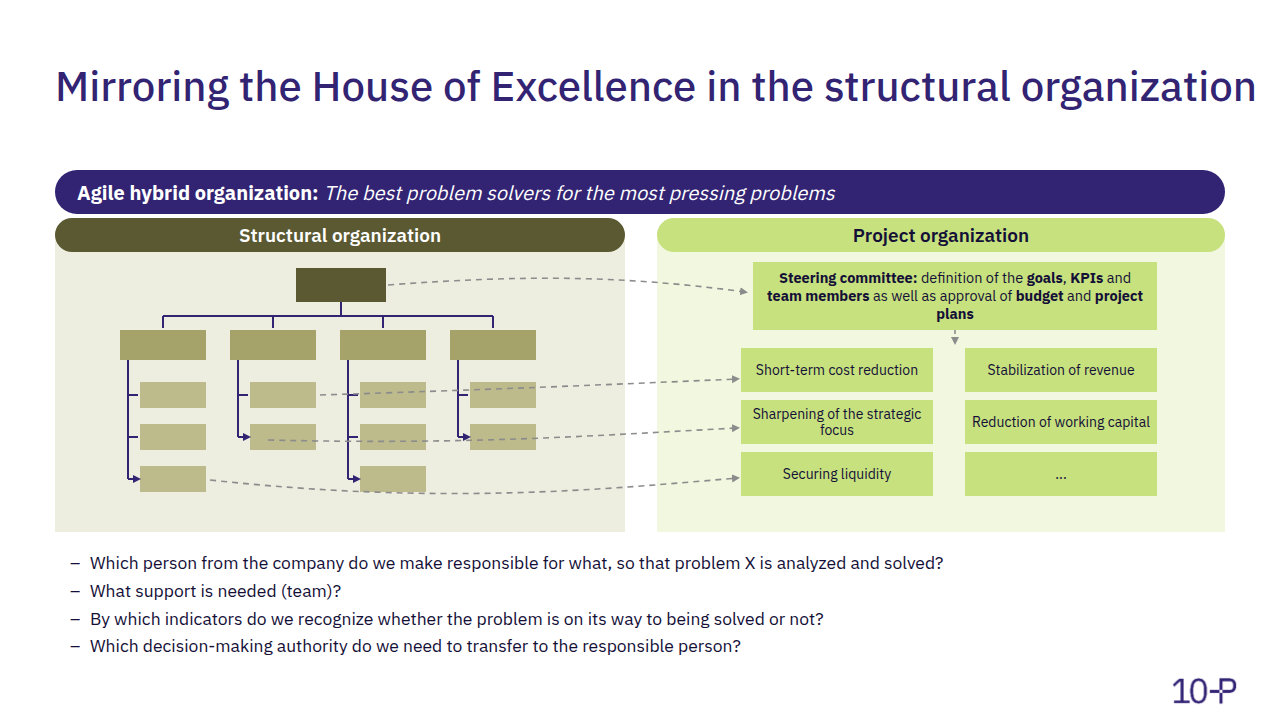
For this, it is necessary to formulate one or more clear, quantitative targets for each action area and to define precisely how progress toward achieving the targets will be measured at short intervals and how the corresponding key figures will be communicated. Maximum transparency is a central building block of success in the restructuring phase, without which success is very unlikely.
In addition, it must be defined which decision-making authority is transferred to those responsible for the action areas. This design essentially depends on the task itself, the transparency already available on the development of the key figures, and the qualifications of the person bearing responsibility.
In this way – without intervening in formal structures – we have initially created, for the most important action areas, a form of organization that concentrates on one central task at a time. Here we recommend, depending on the size and complexity of the company, addressing as a rule no more than 6 to 7 action areas simultaneously, because otherwise the overview can be lost very quickly.
In addition to defining the hybrid organization, it must also be defined how the steering committee is to be set up: participants, chair, and meeting cadence, dates for the coming 6 – 12 months, and the duration of each meeting are to be defined at the start of the work.
4. And what is NEW about this?
Usually, in restructuring phases, consultants are called in who proceed in principle in a comparable way – but with their highly qualified consulting teams. With the company's support, they work through the action areas identified with management on their own: they analyze the causes of the problem, develop solution concepts, and draw up implementation plans. This comes, however, with the major disadvantage that the accumulated knowledge and the experience gained end up in the heads of the consultants and benefit the company only indirectly, for as long as the consultants are in the house. A know-how transfer from the consulting team into the company generally takes place only to a very limited extent. Put differently: in the best case, the problem is solved for now, but the problem-solving capabilities within the company are still the same – namely, far too low. From our point of view, this is not sustainable, because the company was only indirectly involved in the problem-solving process. Not infrequently, the action area is in a desolate state again after two or three years – and a new consultant is needed.
The 10-P approach differs fundamentally from this. Our contribution is the methodological approach and the steering of the project. The substantive work is largely done by the company with its own resources and its own know-how. On request, additional problem-solving capacity can certainly be provided – but that is the exception rather than the rule.
The disadvantage of our approach: it takes longer until presentable results are available. In-house teams can only in the rarest cases keep up with the analytical competence of external consultants, not to mention the time commitment per week. That is why, in the turnaround phase, it is entirely appropriate to work with external consultants, since time is pressing because heavy losses lead to a cash drain.
The advantage of the approach presented is obvious: the company is enabled to solve problems independently, and the competencies established within a project organization can, once successes become visible, be transferred without disruption into an adapted organizational structure.
5. And how is the hybrid structure transferred into an adapted line organization?
As described at the outset, at the start of the restructuring we are dealing with a hybrid organization consisting partly of line functions, projects, and task forces. In our experience, it is quite possible to work this way for a period of 1 to 2 years before sufficient experience has been gathered to transfer the hybrid structure into a new line organization. The path outlined is a very smart approach for converting a strictly functional organization into a process-oriented organization step by step and without major friction.
It depends very much on the individual action areas which tasks must be anchored in what form in an adapted organizational structure. A very individual approach is required here. One thing, however, is quite certain: responsibility for defined performance parameters must be clearly and unambiguously settled, combined with the necessary decision-making authority and unambiguous criteria (KPIs) for measuring the state of the action area. Responsibility, decision-making authority, and measurability must always be in sync!
6. Leadership
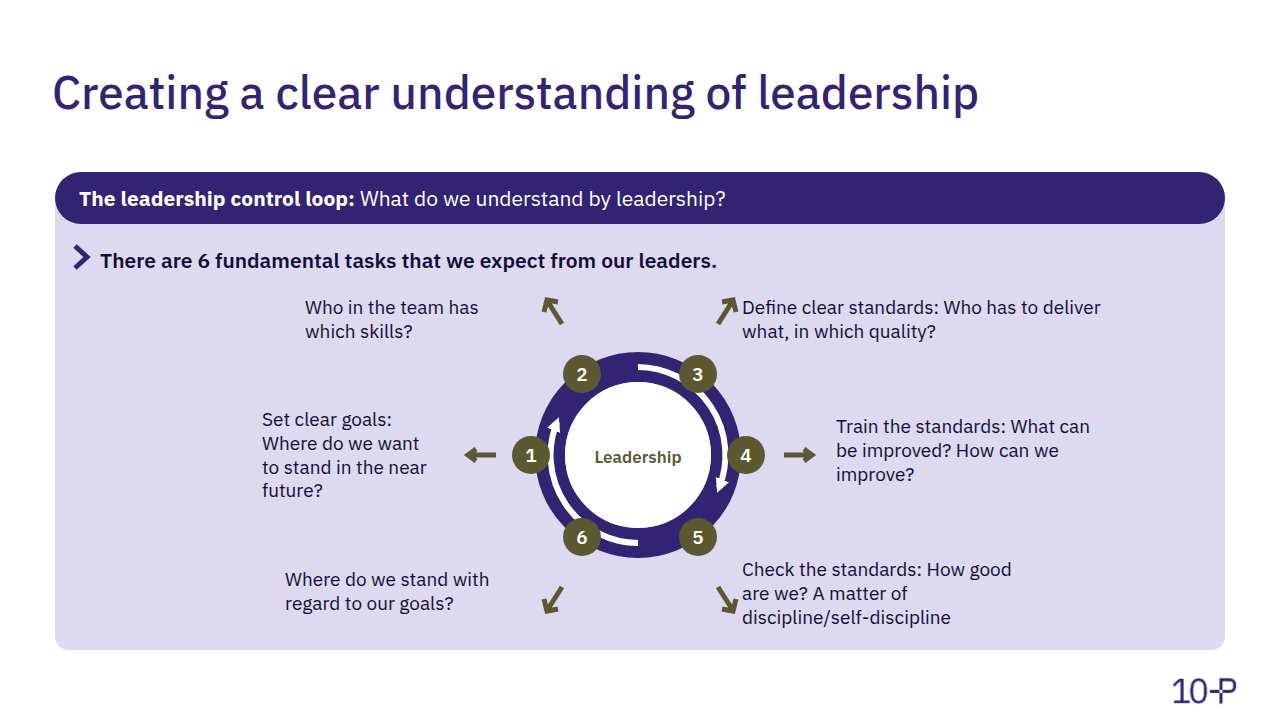
Alongside unclear organizational responsibilities, the second central weak point in almost all companies we have seen in the restructuring or turnaround phase is the topic of "leadership". It begins with the question of what is even understood by leadership. Too often, employees who have stood out through exceptional performance have been promoted to leadership positions without being properly prepared for this new task. Leadership means setting goals for employees and defining standards! That, in a nutshell, is "leadership". In other words, the opposite of self-optimization and self-service – but please do not confuse it with personal responsibility, which cannot be valued highly enough.
Often, however, a lack of leadership hinges precisely on the sticking points mentioned above: if responsibilities and decision-making authority are not clearly and unambiguously settled – then qualified leadership is not possible either. And if, on top of that, key figures are missing to measure a unit's level of performance – then leadership becomes very difficult to impossible.
So another building block on the path of leading the company out of restructuring and back into optimization is the targeted promotion and establishment of a holistic understanding of leadership.
For this purpose, we have developed the so-called leadership control loop, which covers all the essential elements of our understanding of leadership in 6 steps. The implementation of the individual elements of the leadership control loop takes place in parallel with the work on the action areas – "learning by doing on the job", so to speak.
7. Institutional Learning
As mentioned at the beginning, there is hardly a company with a long tradition that has not at some point had to go through a restructuring phase. This is absolutely nothing unusual and is part of entrepreneurial life in a global market economy.
What matters is that restructuring does not become a permanent state, and that tipping into a turnaround must be avoided at all costs. That is why it is crucial, as soon as the organizational prerequisites are in place, to enable as many employees in the company as possible to solve the problems in their immediate area of responsibility independently, in a structured and systematic way, and to consistently seize the opportunities that arise. This again has to do with leadership, but also with the employees' inner attitude. Very often, however, they lack the necessary methodological toolkit to live up to the task. With the help of our BASICON approach, we provide targeted support here – even alongside ongoing projects – for employees in applying different problem-solving tools and the methods and instruments behind them. This, too, is not rocket science and can be learned by all employees. But it simply has to be done.
8. Summary
When a company is in the restructuring phase, there are many ways to break free of it again.
This paper describes a path proven many times in practice, showing how, through relatively simple and unspectacular measures, a company can succeed over a period of 2 to 3 years in leading itself out of restructuring through its own effort and becoming successful in the long term and sustainably. The linchpin is the project design combined with the creation of clear responsibilities and a high level of transparency about performance progress in the defined action areas, flanked by measures to improve employees' problem-solving abilities and the establishment of clear leadership standards.
The options for support from 10-P range from simple coaching of the company's CEO to a complete offering of a project setup as described at the outset. The decision lies with management as to which support is specifically needed and where.
We are proud when a company, with our support, succeeds in freeing itself sustainably from restructuring and even advancing into the phase of transformation. That is a very high aspiration, but what would the world be without lofty goals? Numerous successful examples prove that it is possible.
Further articles:
Institutional Learning 1 (Post #3)
Dynamization through Institutional Learning (Post #2)
Transformation: from Mediocrity to Peak Performance (Post #11)
Where does your company stand?
The Corporate Health Check quickly shows where your company stands and which levers have the greatest impact. Let's get to know each other in a no-obligation conversation.
Request a meeting

