Restructuring Case Study: How a Global Component Manufacturer Returned to Profitability
How a Swiss company with a long tradition and worldwide operations stopped the slide, turned a negative EBITDA into a positive EBIT within 18 months, and established the House of Excellence as a steering instrument that secures the restructuring results for the long term.
The starting position in 30 seconds
Situation. A Swiss industrial company with more than 70 years of history develops and manufactures electromechanical precision components for demanding customers in industrial automation and automotive. Production plants in Europe and Asia, sales across three continents, a technologically excellent product portfolio, and long-standing relationships with the world's leading technology groups.
Complication. Behind the strong brand, the business had started to slide: revenue fell by a quarter within two years, from more than EUR 200 million to EUR 156 million – even the EBITDA margin turned negative. The causes were largely homemade: based on an over-ambitious strategic plan, the company had invested more than EUR 100 million over five years and built up headcount. Utilization did not follow; depreciation did. The products were technically brilliant, but in part over-engineered and too expensive. Operations worked in silos, without transparency on process times, scrap, and margins by product group. And at its most important customer, a global technology group, the company had lost its sole-supplier status because of capacity bottlenecks – the competition was invited in. Declining earnings, a creeping loss of competitiveness, a growing backlog of problems: the classic condition of restructuring.
Solution. Not an across-the-board cost-cutting exercise, but a systematic restructuring program: create transparency, clean up the cost base, reorganize the production footprint, systematize sales, and anchor all of it with the House of Excellence as a steering instrument at management level. We described how this approach works in principle in the article “Restructuring: Mastering the Crisis”. This article shows the implementation in a global manufacturing company.
Step 1: Create transparency – you can only manage what you can see
The first finding was sobering: the company did not know precisely where it was making money and where it was not. So the starting point was not a list of measures, but measurability. A consistent product costing system across all plants was introduced centrally at headquarters and then rolled out globally, complemented by monthly tracking of revenue and margin by product group. A task force made process time and scrap deviations fully transparent and drove their lasting optimization.
The result of that transparency: the priorities suddenly became obvious. Two product families turned out to be the real earnings drivers, while individual groups were running at a negative margin. Only this picture made fact-based prioritization possible – the foundation of every effective restructuring and the core of our Corporate Health Check.
Step 2: Clean up the cost base – consistently and selectively
Building on the newly created transparency, a rigorous cost program followed:
- Personnel costs were reduced by 9 % despite collective wage increases, around 100 full-time positions, primarily in indirect functions and through consistent low-performer management.
- The cost of the most expensive outsourced service, surface finishing, was reduced by EUR 1.3 million.
- Further cost potential of more than EUR 2.5 million was identified and realized.
The sequence was decisive: measure first, then cut. That way the program hit the cost drivers instead of the substance. The result: the German home plant turned to a positive EBIT within 18 months.
Step 3: Reorganize the footprint – value creation where it is competitive
Labor-intensive cable assembly was relocated from the German home plant to the Asian production site: more than 90 articles, in the middle of the Covid pandemic, carried by a dedicated project team. The effect: manufacturing costs fell by more than 20 %, and the margin from the cable business almost doubled, from around 24 to more than 40 %.
In parallel, end-to-end supply chain management was established: a matrix organization across the entire value chain, from purchasing through stamping, injection molding, and final assembly to logistics, with clear responsibilities and a single ERP system as its backbone, rolled out from the home plant to the other sites. Silos became a chain that could be managed.
Step 4: Systematize sales – from reacting to actively attacking the market
Restructuring is not only about cutting costs; without top-line growth, every program remains patchwork. Five sales initiatives were implemented in parallel: a global CRM with a transparent project pipeline, weekly funnel management with strategic «must-win» projects, the separation of key account management and area sales, structured market development in the target segments, and a new compensation model that consistently incentivizes project wins.
The impact was measurable: in a single year, new projects with a total value of around EUR 77 million were won, predominantly from the leading players in the target industries. And the most important customer? Through open communication, transparent dialogue, and restored delivery capability, trust was won back. The supplier rating improved and the company was readmitted to the group of strategic top suppliers.
Step 5: The House of Excellence – a steering instrument, not a poster
Many individual measures do not add up to a successful restructuring. The difference comes from orchestration. That is exactly what the company's House of Excellence was built for: focusing the entire organization on the five decisive fields of action.
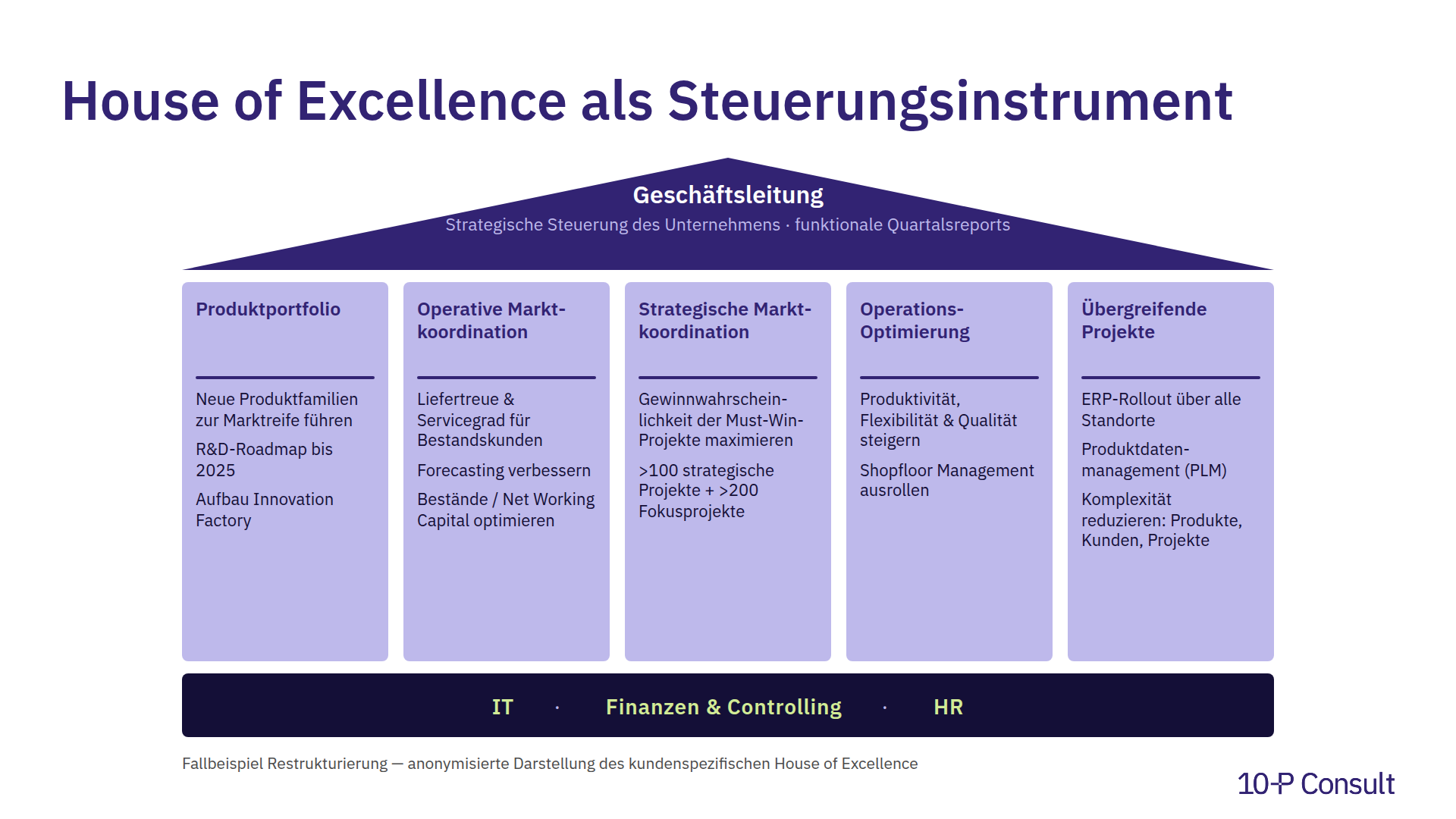
To that end, management established a steering committee and created clear responsibilities for five fields of action:
- A product committee secured the future viability of the product portfolio: new product families, R&D roadmap, and Innovation Factory.
- Operational market coordination improved delivery capability and delivery reliability while reducing inventories across the entire value chain.
- Strategic market coordination managed the more than 100 strategically relevant must-win projects toward results; a further 200 projects were kept under close observation.
- The Operations steering committee improved productivity, flexibility, and quality through shopfloor management in all plants.
- The cross-functional projects optimized administrative processes: modernization of the ERP system, introduction of product data management, and measures to reduce complexity at every level – products, customers, and the project portfolio.
IT, Finance & Controlling, and HR formed the foundation.
The decisive point: the House of Excellence is not a chart for the reception area, it sets the rhythm of leadership. Every field of action had owners, targets, and a fixed cadence for reporting to the steering committee. That is how a backlog of measures became a managed system. Anchoring problem-solving in your own organization instead of outsourcing it to consultants creates value that lasts. We call it Institutional Learning.
The results after two years
- The group is generating a clearly positive EBIT again, through the cost program, transparency, and process discipline
- Delivery reliability improved to around 98 % through product costing, the task force, and shopfloor management
- Margin from the cable business almost doubled, from around 24 to more than 40 %, through the reorganized production footprint
- Around EUR 77 million in new projects won in one year, and a restored standing with the most important customer
- Revenue rebound from EUR 156 million to around EUR 190 million in the following year. That put the company a full year ahead of its own medium-term plan, which foresees a doubling of the EBITDA margin to more than 16 % by the target year
A company with declining earnings and a negative operating result became a profitably growing company again, with a clear equity story – attractive to customers, employees, and investors.
Three key takeaways
- Transparency is half the restructuring. Anyone who does not know margins, process times, and deviations by product and by process is restructuring blind. Only measurability makes prioritization possible, protects the substance from across-the-board cuts, and prevents wrong decisions.
- Cost reduction and growth belong in the same program. The cost program stabilizes, but it is the systematized sales pipeline and the right incentives that turn the restructuring into a growth story.
- Without a steering instrument, every initiative fizzles out. The House of Excellence bundles the decisive priorities under a steering committee, with clear responsibilities, targets, and a fixed meeting cadence.
Is your company facing similar challenges? The Quick Health Check shows in five minutes which state your company is in and which fields of action offer the greatest leverage – as a five-page profile, reviewed by an experienced consultant and free of charge. Start the Quick Health Check.
Note: This case study is based on a real mandate. To protect the client, the name, industry details, and identifying information have been anonymized or generalized.
Further articles:
Restructuring: Turning a problem into opportunities (link)
Restructuring Case Study: From Crisis to Peak Performance (link)
Turnaround Case Study: When the Flagship Product Becomes a Risk (link)
Where does your company stand?
The Quick Health Check places your company in our state model in five minutes – as a five-page profile, reviewed by an experienced consultant and free of charge.
Start the Quick Health Check

