CHARACTERISTICS

Every system a project, every project a risk

In automation and intralogistics, money is mostly made in projects. Whether a project pays off is decided in the quotation, in engineering and at commissioning.

Project management decides. Engineering, controls and software dominate value creation. Without tight project management, deviations only become visible with the final invoice.

Fixed price, deadline, acceptance. Projects are usually sold at a fixed price. Delayed commissioning and open punch-list items postpone acceptance and with it the final payment.

Order intake fluctuates. A few large projects determine utilisation. Without systematic new customer acquisition, gaps arise between two orders.

Standard components under price pressure. In robots and standard modules, Asian suppliers are gaining share. Differentiation comes from solution expertise, service and reliable execution.

Market situation · As of November 2026

The industry is shrinking for the second year in a row

The VDMA expects revenue in German robotics and automation to fall by 5 per cent to EUR 14.1 billion in 2026, after minus 7 per cent in the previous year; competitors from Asia are gaining market share. Around 24,800 industrial robots were installed in Germany in 2025, 8 per cent fewer than in the previous year; the International Federation of Robotics (IFR) does not expect a recovery until 2027. Materials handling and intralogistics produced EUR 25.8 billion in 2025, around 7 per cent less, and expects stagnation for 2026.

In Switzerland, the tech industry grew in the first half of 2026, driven almost exclusively by large companies. SME revenues fell by 3.8 per cent, and around one in four companies in the industry had a negative EBIT margin.

In a shrinking market, execution determines the result. Those who have project margins, engineering hours and cash flows under control will get through the dry spell and win when demand returns.

Sources: VDMA Robotics + Automation, 24.02.2026; IFR World Robotics 2026, 24.09.2026; VDMA Materials Handling and Intralogistics, February 2026; Swissmem, press release of 24.08.2026.

−5%

Revenue forecast, robotics and automation Germany 2026

EUR 14.1 bn

Expected revenue 2026

−8%

Robot installations Germany 2025

−7%

Production, intralogistics Germany 2025

±0%

Intralogistics forecast 2026

−3.8%

Revenue of Swiss tech SMEs, first half of 2026

Early warning signals

How to recognise that action is needed

A single project can go wrong for many reasons. It becomes critical when patterns repeat. The following structural signals show that it is not a project but the company that has a problem – long before it becomes visible in the income statement.

  • Projects are regularly completed late or over budget. Delayed acceptance and price concessions are considered normal.
  • Every project is developed from scratch. Proven modules, standards and templates for engineering and software are missing.
  • There is no standard process for change requests. Additional work is done but rarely assessed and agreed before implementation.
  • Experience does not flow back. Lessons from completed projects do not find their way into new quotations and costings.
  • Sales reacts instead of steering. New orders come through existing contacts; new customers and applications are not approached in a targeted way.
  • Projects only succeed with extra effort. Planning, control and coordination in project management do not run smoothly; overtime and special efforts make up for it.

The list is not exhaustive. If several signals apply, the cause usually lies in structures and processes, not in individual projects. The Corporate Health Check shows exactly where: an independent assessment across ten dimensions of the company with prioritised fields of action.

More about the Corporate Health Check
Strukturelle Frühwarnsignale im Projektgeschäft: Termine und Budgets, Engineering, Änderungen, Lernen, Vertrieb und Projektmanagement (nicht abschliessend)

Levers

Five levers for earnings and liquidity

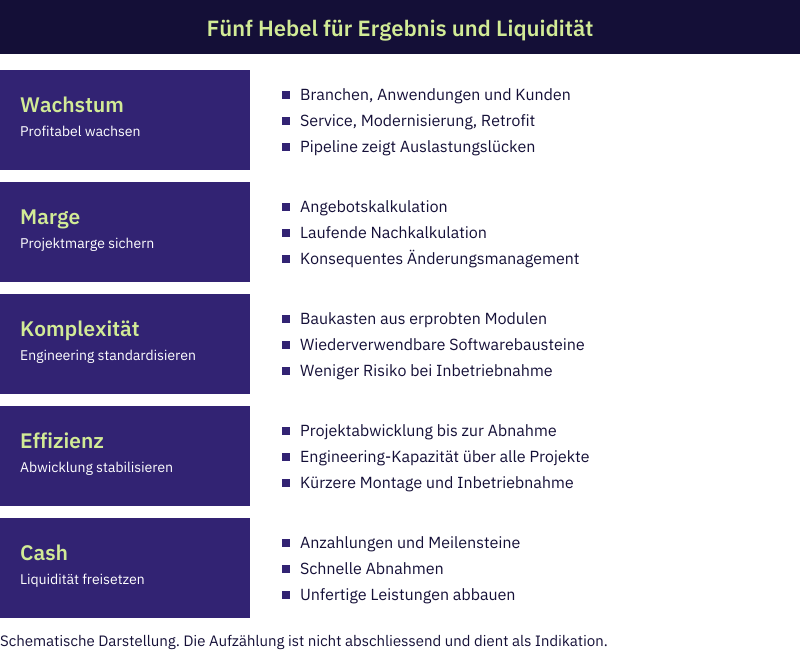
Earnings and liquidity rarely depend on a single department. Growth, margin, complexity, efficiency and cash influence each other and should therefore be considered together.

Growth. Define target industries and applications, build up service, modernisation and retrofit as steady business and steer new customer acquisition via a weighted pipeline. New markets are opened up as part of a transformation.

Margin. Base quotations on post-calculated actual values, track the project margin continuously and assess and agree every change before implementation. These are typical building blocks of an optimisation.

Complexity. Standardise recurring solutions as proven modules and software building blocks. This reduces engineering effort and commissioning risk. More on this in the article Peak performance through strategic focus.

Efficiency. Introduce uniform project management from order to acceptance and plan engineering capacity across all projects. How this succeeds with your own teams is shown by Operational Excellence.

Cash. Agree down payments and milestone payments, accelerate acceptance and reduce work in progress. If liquidity is tight, working capital becomes the core of a restructuring.

Fünf Hebel für Ergebnis und Liquidität in Automation und Intralogistik: Wachstum, Marge, Komplexität, Effizienz und Cash mit typischen Ansatzpunkten

KPIS

Which KPIs management in automation and intralogistics should see every month

The early warning signals show where structures and processes are weak. KPIs measure where the company stands and whether measures are working. A few reliable figures are enough – monthly, comparable and forward-looking.

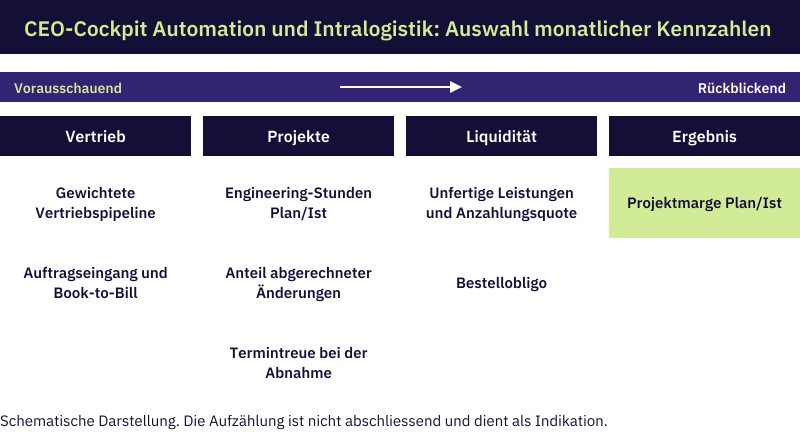
  • Weighted sales pipeline: shows which order intake is realistic in the coming months.
  • Order intake and book-to-bill ratio: show early whether the order backlog is growing or shrinking.
  • Project margin plan vs. actual: shows for each project whether the costing holds.
  • Engineering hours plan vs. actual: shows where design and software exceed the budget.
  • Share of invoiced changes: shows whether additional work is also paid for.
  • On-time acceptance: the share of projects accepted on the promised date.
  • Work in progress and down payment ratio: show how much capital is tied up in ongoing projects.
  • Purchase commitments: make future cash outflows visible before they occur.
CEO-Cockpit Automation und Intralogistik: Auswahl monatlicher Kennzahlen zu Vertrieb, Projekten, Liquidität und Ergebnis

The selection is not exhaustive; which KPIs fit depends on the business model. In the CEO cockpit, we bring these KPIs together on three levels, from management to the core process.

More about the CEO cockpit

Our key topics

With tailored approaches and proven methods, we support you in aligning and developing your company — independently, and starting from your current economic situation.

Transformation: engineering and office area of an industrial company

Transformation

Sharpen your strategy and develop a holistic alignment to realize growth opportunities.

Learn more
Optimization: production area with assembly workstations and material flow

Optimization

Increase your problem-solving capacity and develop your organization from mediocrity to peak performance.

Learn more
Restructuring: production hall with machinery and operator workstations

Restructuring

Secure your company's viability through structural interventions and sustainable earnings optimization.

Learn more
Turnaround: production area of an industrial company with machinery and employees in motion

Turnaround

Secure your company's liquidity and continued existence and restore its earning power for the long term.

Learn more

FROM PRACTICE

Steer before things get tight

CEO-Cockpit für die operative Unternehmenssteuerung

CEO cockpit for an industrial group in automation technology

An internationally active industrial group in automation technology wanted to achieve three goals: higher gross profit, faster response to market and customers, and higher productivity in direct and indirect areas. Together we defined the levers for sales and order fulfilment, set the performance parameters and built the cockpit as a repeatable template. The result is a steering instrument that creates transparency.

More about the CEO cockpit
Fallbeispiel Optimierung bei einem Sondermaschinenbauer

Optimisation at a special machine builder

A globally positioned special machine builder with a double-digit return on sales realised that its technology base was reaching its limits: inadequate project management, high complaint rates and poor delivery reliability. With six building blocks and its own teams, the company launched the optimisation under its own steam.

Read the case study

EXPERIENCE

Management and hands-on experience from industry

Our team combines management experience with technical, hands-on experience from industry. We know manufacturing companies not only from analyses but also from being responsible for results, employees and customers. That is why we speak the same language as your management and your production, and our solutions work in everyday operations.

More about us

FREQUENTLY ASKED QUESTIONS

Frequently asked questions about consulting in automation and intralogistics

Which companies in automation does 10-P Consult work for?

For manufacturers and system integrators in automation, robotics, assembly and handling technology, machine vision as well as conveyor and storage technology with around 30 to 500 employees in German-speaking Switzerland and southern Germany.

How do you improve project margins?

With quotation costing based on post-calculated actual values, ongoing project control with plan-versus-actual comparison and change management that consistently invoices additional work.

How do you reduce engineering effort?

By standardising recurring solutions as modules and software building blocks. Every project remains customer-specific but no longer starts from scratch.

How do you bridge fluctuations in order intake?

With a weighted pipeline that shows gaps early, cross-project capacity planning and a service and retrofit business that generates revenue independently of large projects.

What if the situation is already critical?

Then securing liquidity takes priority. On request, we take over interim management or the role of Chief Restructuring Officer as part of a consulting mandate.

More about turnaround

How does a collaboration begin?

With an assessment of where you stand. The Quick Health Check takes five minutes to complete and shows what state your company is in and which fields of action offer the greatest leverage – as a five-page profile, reviewed by an experienced consultant and free of charge.

ASSESSMENT

Where does your company stand?

The Quick Health Check takes five minutes to complete and shows what state your company is in and which fields of action offer the greatest leverage – as a five-page profile, reviewed by an experienced consultant and free of charge.