
AI in Consulting: The Structure Still Comes from the Consultant (Part 2/2)
In part one (link) we described the levers that AI agents unlock in consulting for industrial companies: standardized methodology, team output from a single consultant, multiplied experience, analyses in hours instead of weeks. This second part is about the less comfortable half of the truth.
Ask an AI an open question – “Analyze our market” – and within minutes you get a document that looks like consulting. It is well written, confident in tone, neatly structured. Whether it is correct is another matter. This is exactly where professional use parts ways with gimmickry.
Without defined standards, speed becomes a risk
Using AI only makes sense where cleanly predefined standards and methods exist. That is not a side note – it is the central condition. A method defines which sources count as reliable, how things are measured, which comparison groups are used, and where thresholds lie. Only these definitions make a result verifiable – and therefore usable.
Without the method, AI produces not analyses but plausible-sounding arbitrariness – in high volume. The dangerous part: it looks like the real thing. The effort of correcting a poorly founded document after the fact is often greater than setting the work up cleanly from scratch. Speed without a standard therefore accelerates one thing above all: the path to the wrong decision.
The structure comes from the consultant – not from the machine
Every good consulting product starts with structure: Which question is decision-relevant? Which hypotheses need testing, and in what order? What should the final document on the table look like? This architecture is something AI cannot deliver. It knows neither the company nor the decision context – and it bears no responsibility for the result.
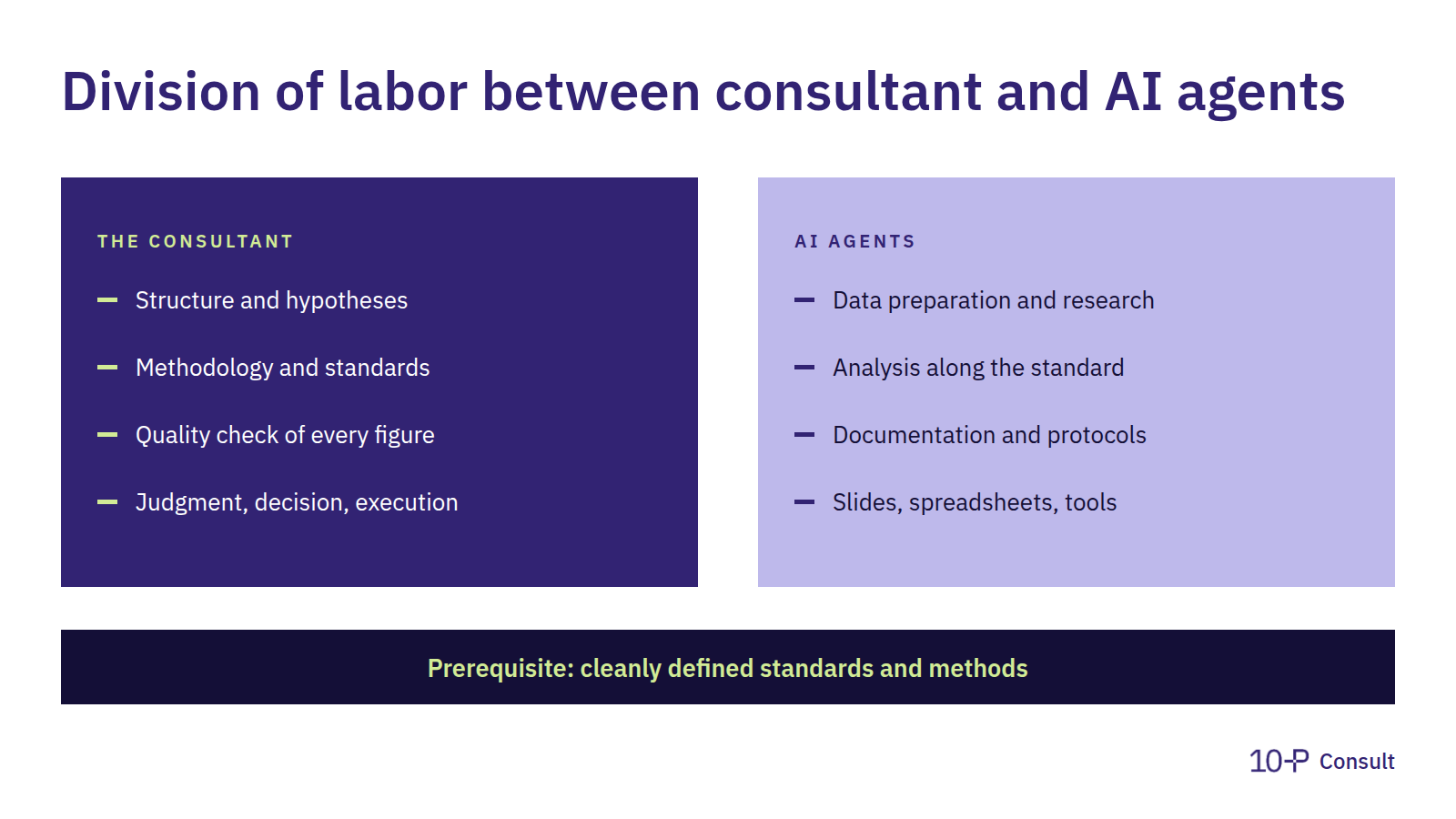
In our engagements, segmentation, analytical logic, and storyline come from the consultant; the AI fills this structure with cleanly prepared substance. Where the order is reversed – generate first, then look for a structure – the result is a lot of material and little message.
Quality assurance remains a leadership task
AI systems make mistakes, and they make them with a convincing face: an imprecise source, a wrongly transferred figure, a false precision that suggests reliability where assumptions stand. Anyone working with them needs a simple rule: every decision-relevant figure is checked, every source verified, every calculation retraced.
The classic four-eyes principle is inverted in the process: the senior used to review the junior's work – today the consultant reviews the machine's work. Responsible for the result is not the tool, but the person who presents it to the client.
Confidentiality and data discipline
Consulting works with the most confidential material a company has: calculations, customer lists, personnel data, strategic intentions. Using AI therefore demands clear rules: which data may go into which systems, when data is anonymized, and on what contractual basis processing rests. This concerns the choice of systems as much as everyday behavior: professional environments with contractually secured data processing are something different from freely available consumer tools into which sensitive documents are “quickly” copied. Whoever cannot answer these questions should not put client data into AI systems. Full stop.
What AI does not replace
No model stands on the shop floor and sees that material supply is stalling. None senses in the leadership circle that the production manager is embellishing the numbers, or wins the trust of a patron who must hand over his life's work. Diagnosis begins in conversations, implementation lives on leadership – and resistance to change is not resolved by a better document, but by people who convince.
AI considerably accelerates the analytical half of consulting. The entrepreneurial half – judging, prioritizing, convincing, implementing – remains handcraft.
The consultant's new role
The profile shifts accordingly: the consultant moves from producer of analyses to architect of the methodology and quality authority. He defines standards, sets the structure, reviews results, and translates them into decisions. Experience becomes more important as a result, not less – because only those who can judge can review, and judgment comes from years in real projects, not from computing power.
For consulting approaches that rely primarily on large junior teams and billed person-days, however, things are getting tight. The value will lie even more visibly where it always lay: in methodology, judgment, and implementation strength.
Recommendation
For companies that want to use AI themselves – in-house or through their consultants – we recommend three steps. First: method before automation. Define the standard first – what is measured how, what counts as reliable – before handing it to an AI. Second: name responsibility. For every AI-supported analysis it must be clear who is responsible for structure and quality – by name, not “the tool”. Third: start small. Recurring, cleanly defined tasks first – not the fundamental strategic question.
And when you buy consulting: ask to see the standards the work is based on. Those who can show them use AI as an amplifier of their methodology. Those who cannot are selling you speed without substance.
Further articles:
AI in Consulting: When One Consultant Works Like a Team (Part 1/2) (link)
The Leadership Control Loop: From Goal to Execution (link)
Institutional Learning (Part 2/2) (link)
Optimization Case Study: When Technology Leadership Is No Longer Enough (link)
Where does your company stand?
The Quick Health Check places your company in our state model in five minutes – as a five-page profile, reviewed by an experienced consultant and free of charge.
Start the Quick Health Check

