
The Leadership Control Loop: From Goal to Execution
When I ask entrepreneurs and managing directors about their companies' financial goals, the answers come pouring out: revenue targets, profit targets, returns, market shares – we all know them. But when I follow up by asking how these top-level goals are broken down across the organization – who in which functional role is concretely responsible for them and how it is all monitored – things often go very quiet.
Admittedly, it is not easy. But it is absolutely doable – and indispensable if you want to gear your company toward peak performance.
Goals must be broken down to every business unit
What many people are not aware of: if your company operates in several business fields, you have to run through the leadership control loop for each individual business unit with its own combination of offering and market.
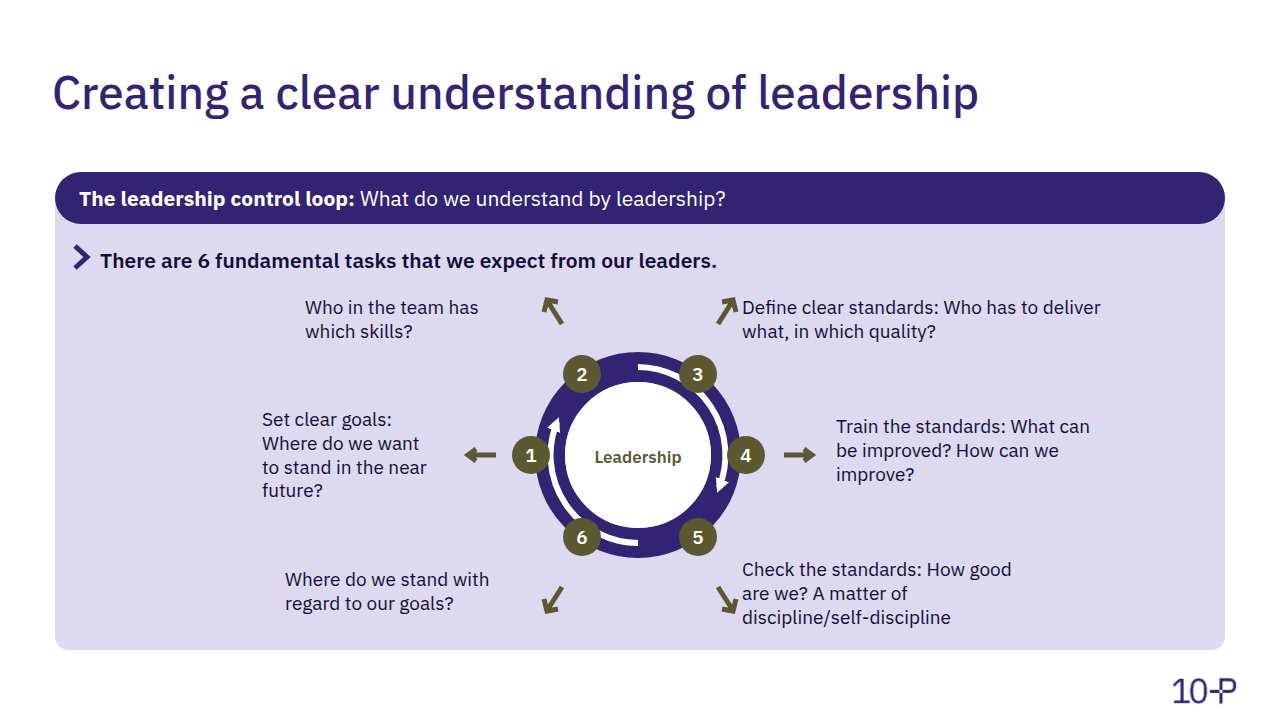
Step 1: Set clear goals
Let us assume your strategy is in place. That means: the answer to the question of what sets your offering apart from the competition in a sustainable way is clear.
Now you need to define which central success factors determine whether you reach your goals or not. Typical examples include:
- superior products with a strong price-performance ratio
- distinctive services
- a broad product range or assortment expertise
- consulting excellence in customer conversations
- concrete performance guarantees
- on-time completion of projects
It is always these distinctive achievements that turn a company into a top performer – and keep it viable for the long term.
Align the organization with the success factors
The challenge now lies in interlocking these differentiating capabilities with the organizational structure in such a way that the goals are actually achieved.
Often it is hundreds or even thousands of employees who have to work toward shared goals across many interfaces.
Experience shows that three performance streams need to be synchronized:
- Innovation management – ensures that your portfolio of offerings remains competitive.
- Service delivery (supply chain) – takes care of operational execution.
- Customer management (sales) – brings the value to the market.
These main streams should be organized with as little overlap as possible to enable clear responsibilities.
All supporting functions – finance, IT, HR – have one task: to support the performance streams as effectively as possible. That is why they are often referred to as business partners.
Step 2: Define measurable goals
Now we get to the core of the leadership control loop: you must define concrete, measurable goals for all main and supporting functions – short, medium, and long term.
Measurability is decisive.
The starting point is always your customers' expectations. What do we have to achieve in the performance streams to be perceived, over the long term, as the best provider in our market segment?
Do not be discouraged if the current figures are far from that mark. The gap is normal – if performance has not been managed consistently so far. This is where you need the courage to set ambitious targets, even if some employees smile at them or even reject them at first.
An example: the furniture manufacturer under pressure
An office furniture manufacturer is under pressure from cheap imports from China. But conversations with dealers reveal: the Chinese products have delivery times of up to three months, are sold only by the container, and are neither customizable nor consistently high in quality.
The manufacturer's strategy could read:
"We offer standard furniture in small quantities with a 2-week delivery time, around 20% more expensive than Chinese suppliers – but with a 5-year quality guarantee and batch size 1 for custom orders."
This results in a completely different value chain:
- Flexible CAD system with a modular design concept
- CAD/CAM integration for automatic transfer to CNC machines
- Minimized setup times (from 2 hours to 10 minutes)
- In-house production with 24-hour material availability
- New coating processes for reduced drying times (from 24 to 8 hours)
- AI support in design and engineering
Only if every one of these process steps is measured can the strategy succeed.
Overcoming resistance
Your employees will say: "That's impossible." But this is exactly where it is decided whether you are ready for real transformation.
Sometimes it helps to lead by example. Sometimes a video of today's way of working is useful. And sometimes only one clear step remains: employees who persistently refuse must be replaced.
Do not let yourself be stopped on this path – break through resistance, even when it is stubborn.
Step 3: Define standards
One of the things that distinguishes a good company from a less good one is clear standards for all processes.
Whether it is a customer visit, CRM maintenance, or proposal follow-up – without standardization, everyone works according to personal taste.
This leads to:
- an inconsistent appearance
- unusable data in the CRM
- untapped potential in customer management
Only with standards do you get reliability, comparability, and a sound basis for decisions – across all areas of the company.
Steps 4–6: Train, monitor, adjust
Standards must be defined, trained, and continuously reviewed – ideally daily, not just monthly.
If, despite all these measures, no improvement occurs, the reason is usually clear: either the goals were unrealistic or the standards were not followed.
In both cases: you know what to do.
Conclusion: Take responsibility, enable peak performance
It is not the fault of politics, the Chinese, or Donald Trump.
It is in your own hands.
If you implement the leadership control loop with full consistency, your company's performance will improve measurably – and lastingly.
I wish you every success on this path – and the courage to be clear.
Further articles / links
- Problem-solving-oriented leadership (link)
- Peak performance through transparency (link)
- Entrepreneurs within the company (link)
Where does your company stand?
The Corporate Health Check quickly shows where your company stands and which levers have the greatest impact. Let's get to know each other in a no-obligation conversation.
Request a meeting

