
The BASICON Method
The world – and even more so the world of the Mittelstand – has become complex to a degree never seen before. This is not overdramatization but a sober look at the developments of recent decades. The change is most striking in the field of technology. It was not long ago that the internet was something for initiated computer professionals only, mobile phones were unheard of, and AI was most likely taken for a place in Asia. That was the world just 30 years ago. But the shifts on other levels are breathtaking as well. The end of the era Hobsbawm called the short twentieth century brought immense political upheavals that opened up new markets but also produced new competitors. The latter, with their inexpensive and often genuinely good products, are making life difficult for the manufacturing industry in almost every sector in Europe and North America. Added to this are countless other phenomena that, if not new, have in most cases intensified considerably in recent years and decades. In short: the sheer number of problems – but also opportunities – facing companies has grown exponentially. Companies, especially those of the Mittelstand, are now called upon to deal with these new problems efficiently and to seize the opportunities that are emerging.
BASICON as the methodical answer
BASICON provides a unified, structured method for systematically analyzing these events, developing solutions, and implementing them. In eight clearly defined steps, it helps you act purposefully, document knowledge, and improve together – from individual learning all the way to institutional knowledge building. This article explains the method, shows how it is applied in everyday work, and offers practical guidance for implementation.
Companies under pressure
According to a study by the consulting firm BCG from fall 2024, the German economy is in a precarious position. Up to one fifth of industrial value creation is threatened by glaring structural problems, reflected in weak fiber-optic rollout, the level of education, and the transport infrastructure. In addition, high energy prices and excessive bureaucracy are making life difficult for businesses. But it is not only the macroeconomic situation that is difficult. Companies are also struggling with homemade problems: lagging digitalization, ERP system implementations, efficient processes, and so on.
The Swiss economy is further along here. According to the Federal Council's 2024 situation report, the economy remains very resilient and well positioned to respond to challenges. Yet problems are emerging here too. Labor productivity has risen, but labor input has declined. Combined with demographic change, this has a negative effect on GDP growth. Switzerland's particular geographic conditions also pose a special challenge. According to the KOF Swiss Economic Institute, companies are particularly exposed to physical climate risks. Adequate answers to this have yet to be found.
Companies therefore have more than enough reason to build up and expand their problem-solving capacity in order to overcome the current challenges and turn toward the opportunities. The reality in many companies, however, is unfortunately that they frequently fall back on external consultants to solve their problems instead of building the corresponding capabilities internally. That is short-term thinking, and it stands in the way of creating an organizational structure that is both resilient and responsive.
The BASICON method in detail
The BASICON model is a clearly structured and versatile method for working on problems – but also on opportunities – that arise in a professional environment.
BASICON consists of eight consecutive steps, all of which must in principle be completed. A common mistake in problem-solving approaches is the tendency to jump quickly to solutions without weighing them sufficiently. This is where the method comes in and provides a clear framework.
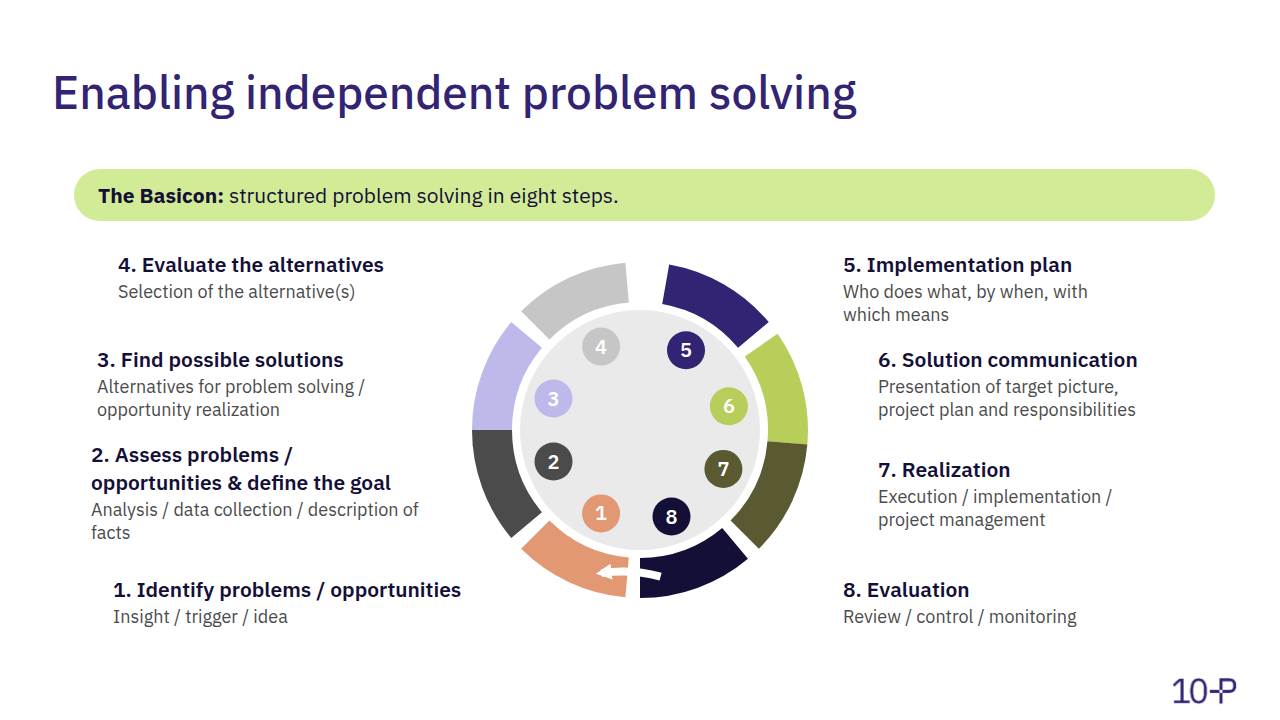
The steps in detail:
- Problem/opportunity identification: The problem or opportunity must be captured as clearly as possible, ideally on the basis of facts and figures. In this step, a clear distinction must be made between the actual problem and its symptoms, so as not to run the risk of tinkering at the wrong end.
- Problem/opportunity assessment: Before moving on to the solution, it is time well spent to reflect on whether a relevant problem or opportunity exists at all. Here too: the more clearly an assessment is based on clearly measurable variables, the more certain you can be that you are not backing the wrong horse.
- Alternative problem solutions or opportunity realization: Only after we have captured the problem or opportunity and its relevance clearly and transparently do we develop possible solution proposals. It is important here to break free from conventions and to allow unusual proposals as well.
- Assessment of alternatives and decision: Now the individual options must be examined more closely for their costs and benefits as well as their opportunities and risks, and the best alternative – or the combination of the best alternatives – must be selected. This decision, too, must be based strictly on facts and figures.
- Implementation planning: Now that we know the best solution for our problem or opportunity, we must break the initiative down into individual work packages and put them into a logical sequence. Do not forget to define clear responsibilities and deadlines and to provide resources; in short: who does what by when, and with which means?
- Solution communication: Of course, the best problem analysis is worthless if the employees affected are not informed and involved. This step is about explaining the overall context to the various teams, motivating them, and ultimately assigning tasks.
- Execution: Now the implementation plan must be put into action. The task here is to make sure that the individual subtasks are completed on schedule, that resources are deployed correctly, and so on.
- Monitoring success: Now that the project is complete, we must examine how successful our efforts were and whether we have really come closer to solving the problem or realizing an opportunity. This requires a high degree of self-criticism – and the perseverance to run through the process a second time if necessary, should the desired results not have materialized.
The method is easy to implement and, with a little practice, can be established in any company. For each of the steps listed, there is also a range of supporting tools that can help you gather data and make decisions in a structured way.
BASICON in corporate practice
We have successfully introduced BASICON in a variety of organizations – most recently in a mid-sized manufacturing company in southern Germany.
The starting position was challenging: in almost all departments, people were working by the book and no more. Obvious improvement potential went unused, everyday problems were simply accepted, opportunities were not seized. Large parts of the company had frozen up – marked by mutual finger-pointing between departments and references to the difficult global economic situation.
It was clear that something had to happen. The company's leadership decided to establish BASICON as a shared language for problem-solving throughout the entire operation. The rollout took place through systematically structured workshops – each consisting of a theoretical part on the methodology followed by a practical part in which real challenges of the respective departments were worked on.
The effect was not long in coming: as soon as employees at all hierarchy levels worked together on the issues that made their daily lives difficult, a momentum built up that could hardly be stopped.
Cross-departmental collaboration and – even more so – the ability to work on existing problems together in a structured way improved to an extent that had previously been unimaginable.
We continue to support the company today through in-depth problem-solving workshops in which employees work on concrete, cross-departmental challenges – with tangible success.
Recommended action for the Mittelstand
Faltering innovation, waning motivation, silo thinking, working by the book – does this sound familiar? Unfortunately, exactly these patterns reflect the reality in many mid-sized companies.
Do not wait until your company is stuck even deeper in this state. Problems in a business environment do not solve themselves – they need structure, clarity, and consistent effort.
With the BASICON method, we have established a new standard in numerous companies for how systematic problem-solving can work – especially for mid-sized operations. The method shows a viable, practice-oriented path for companies to build and anchor their problem-solving capabilities in a targeted way.
The result: instead of lethargy, a new, forward-looking momentum emerges. The organization gets moving again – focused, solution-oriented, and united.
Let's talk.
Further articles / links
Where does your company stand?
The Corporate Health Check quickly shows where your company stands and which levers have the greatest impact. Let's get to know each other in a no-obligation conversation.
Request a meeting

