
Strategy Coaching Case Study: When Innovation Needs a Strategy
How a long-established metal construction company developed a promising product innovation into a viable corporate strategy – in a coaching format, with its own leadership team.
The starting position in 30 seconds
Situation. A long-established metal construction company in Germany generates almost 80 % of its revenue with steel products and custom-made building elements – solid quality, long-standing customer relationships, predominantly commercial projects. The dependence on a few large orders and changing market conditions become the driver for innovation: inspired by ceramic decors from kitchen construction, the company develops a system for prefabricated, highly customizable front entrance doors.
Complication. A good innovation is not yet a strategy. The new product targets completely different customers than the core business, the positioning is open, sales are geared toward commercial projects, and market potential and growth ambition have not been quantified. If the new line is simply “hooked into” the existing structures, it risks sinking exactly there – between day-to-day business, established sales channels, and a public image that addresses the wrong customers.
Solution. Not a classic consulting project, but strategy coaching as help for self-help: guided self-analysis by the company, condensed in three two-day workshops along the 10-P model – through to an adopted strategy with a concrete catalog of measures. Why strategic focus is the lever to peak performance especially for SMEs is described in our article “How SMEs Achieve Peak Performance through Strategic Focus”. This article shows what that looks like in practice.
The approach: coaching instead of an expert report
In strategy coaching we do not develop the solution on our clients' behalf; we support them through questions and structured workshops in defining their own corporate strategy. The frame is provided by our proprietary 10-P model, which covers all essential dimensions of a corporate strategy and ensures a holistic target picture. The proven format combines phases of guided (self-)analysis with three two-day workshops in which the results are condensed and the strategic decisions are made.
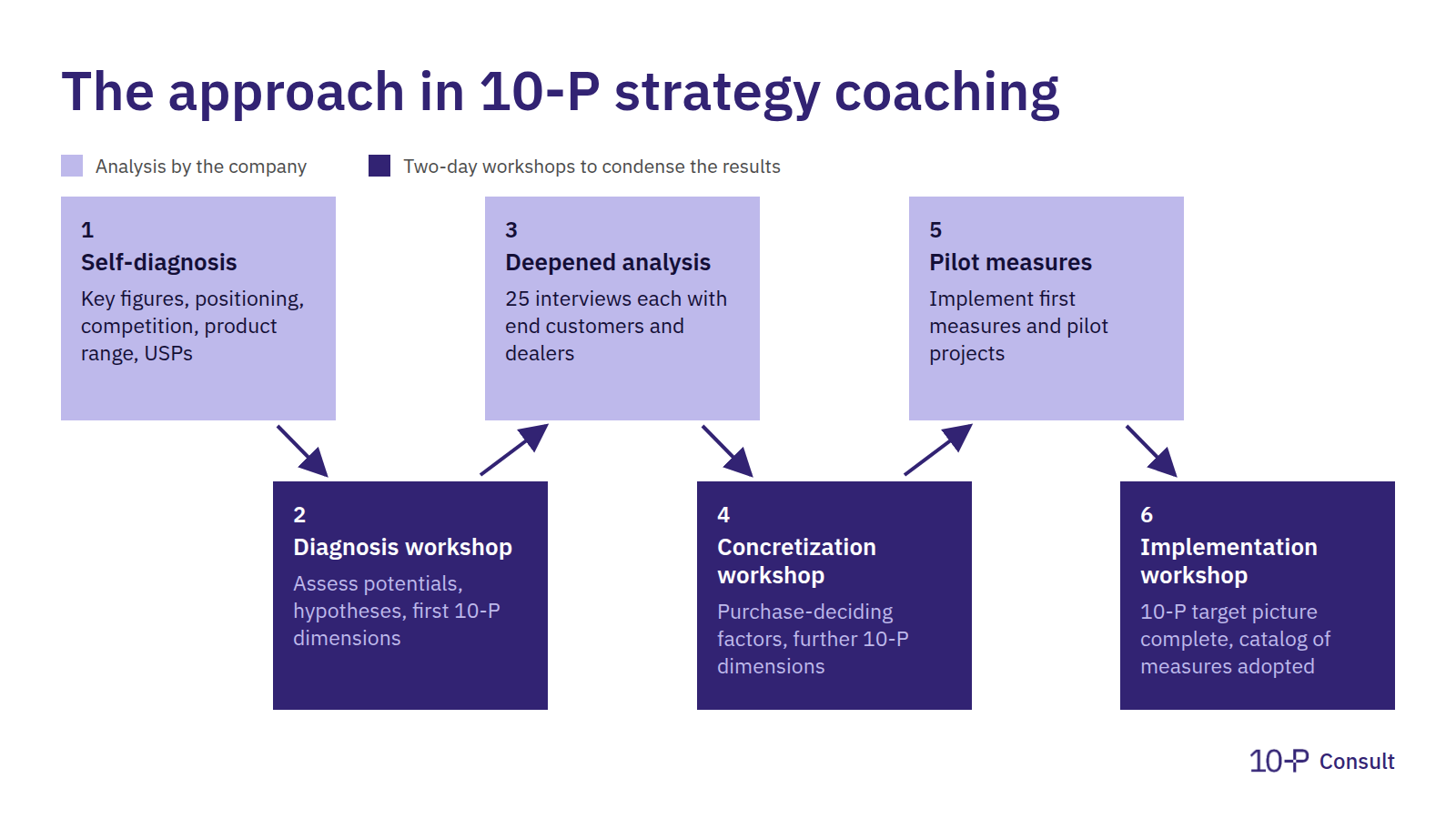
The starting point was a critical self-diagnosis: financial key figures, current positioning, relevant competition, product range, and unique selling points. In the diagnosis workshop, this inventory was deepened together with management, sales, and operations: strengths and potentials were assessed, working hypotheses formulated, and the first dimensions of the 10-P model – such as the competitive arena, target customer segments, and possible sales structures – spelled out. Open questions such as the regional distribution of revenue or costing at article level were taken away by the company as follow-up assignments.
The reality check: 50 customer interviews
An essential element for the success of the coaching were the customer surveys: 25 end customers and 25 dealers each were interviewed by the company itself in order to conclusively understand the needs of the target customer segments. Only this understanding made the purchase-deciding factors visible – and significantly influenced the future external presentation.
In the concretization workshop, the insights from the deepened analysis were taken up, further dimensions of the 10-P model were determined, and first measures and pilot projects were defined. In the concluding implementation workshop, the target picture across all ten dimensions was adopted – together with a catalog of measures ranging from personnel implications through sales targets to individual marketing measures.
The strategic course settings
Analysis, interviews, and workshops led to four course settings that shape the new strategy:
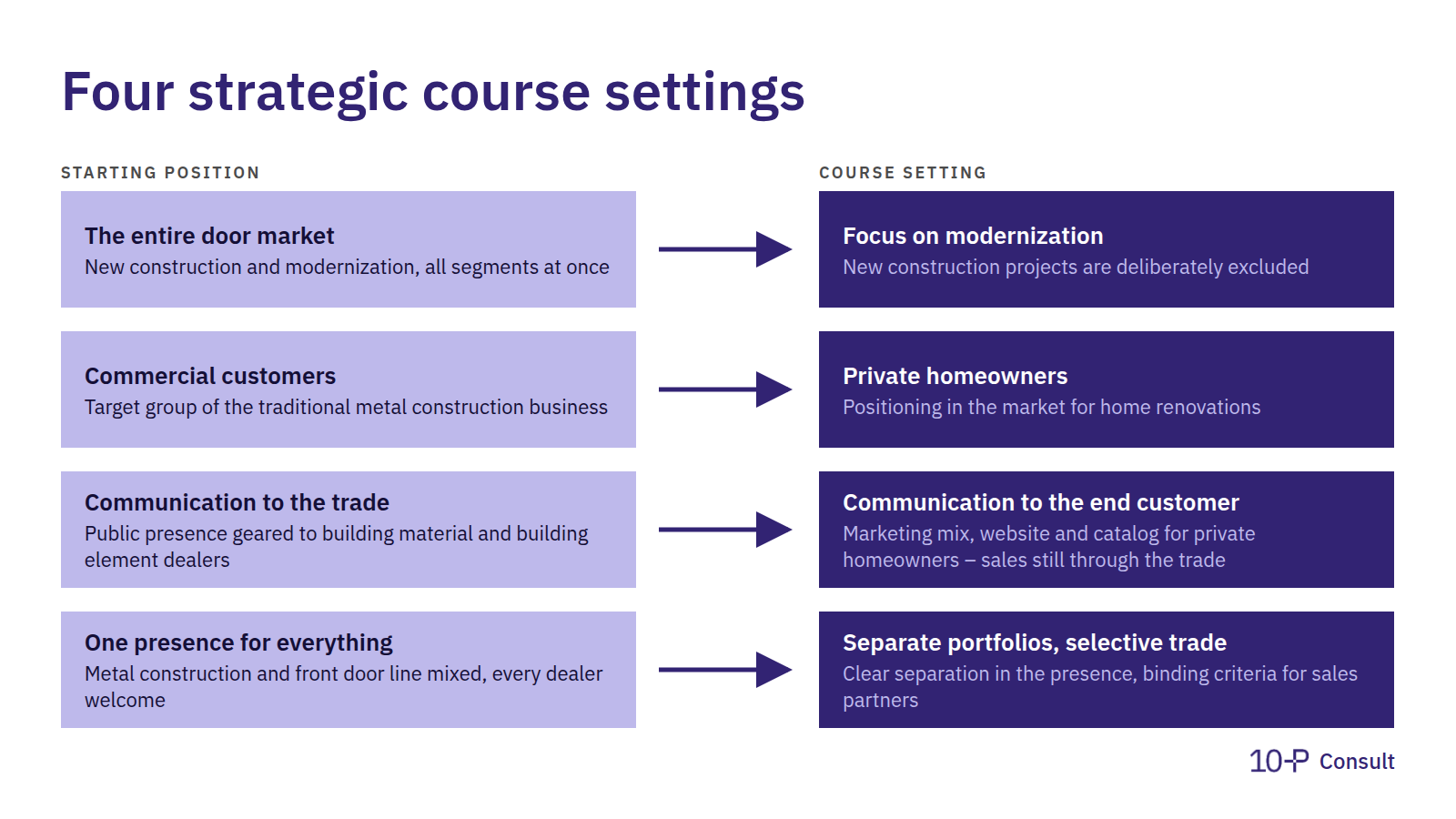
- Modernization instead of new construction. The market for entrance doors is segmented by frame material and by new construction versus modernization. Market analysis and interviews with fabricators and architects showed: only modernization is relevant – new construction projects are deliberately excluded.
- Private homeowners instead of commercial customers. While the traditional metal construction business primarily addresses commercial customers and projects, only private homeowners are relevant for the new front door line – it is positioned in the market for home renovations.
- End-customer communication despite dealer sales. Sales run through building material and building element dealers, but the private end customers are addressed – with a targeted marketing mix and a public presence including website and catalog that is consistently geared to their needs.
- Separate portfolios, selective trade. The different customer segments require a clear separation of the product portfolios – in the external presentation as well as in the sales structures. Binding criteria were defined for the selection of sales partners and a dealer model was developed to reach the target customers more precisely.
The result after six months
After around six months, the outcome was not just a strategy paper but an aligned overall package:
- A holistic corporate strategy based on the 10-P model
- A key figure model for measuring the strategy's success
- A dealer model including selection criteria and targets
- Market size and targeted market shares for the next five years
- Sales targets for revenue and the acquisition of new dealers
- New roles and skills (e.g. branding, online marketing) including job descriptions
- Marketing guidelines as input for the new public presence
- A plan of measures with concrete (pilot) projects to implement the strategy
At least as important: a leadership team that developed the strategy itself – and therefore owns it. Or in the words of the managing director:
“The workshops were very well prepared and followed a binding structure. This made it possible for us to work out the essential insights within a relatively short period of time and to determine the resulting measures. Now it is up to us to tackle the task.”
Three key takeaways
- An innovation is not yet a strategy. A strong product does not answer who buys it, where it is positioned, and through whom it is sold. Only deliberate focus – here: modernization and private homeowners – turns an invention into a business.
- Those who do not ask their customers are guessing. 50 structured interviews with end customers and dealers replaced opinions with knowledge and revealed the purchase-deciding factors. The effort is manageable – the effect on positioning and public presence is not.
- Strategy is created in the company, not in the consultant's office. Set up as coaching, the strategy ultimately belongs to the leadership team – with an acceptance and implementation strength that an externally written concept rarely achieves. Help for self-help, for value creation that lasts.
Is your company facing a similar course setting? The Quick Health Check shows in five minutes which state your company is in and which fields of action offer the greatest leverage – as a five-page profile, reviewed by an experienced consultant and free of charge. Start the Quick Health Check.
Note: This case study is based on a real 10-P Consult coaching engagement. The client's name and identifying details have been anonymized or generalized.
Further articles:
How SMEs Achieve Peak Performance through Strategic Focus (link)
Restructuring Case Study: From Crisis to Peak Performance (link)
Where does your company stand?
The Quick Health Check places your company in our state model in five minutes – as a five-page profile, reviewed by an experienced consultant and free of charge.
Start the Quick Health Check

