
Peak Performance through Transparency (Part 2 / 2)
A look at your monthly CEO reporting tells you which project leads will turn into revenue in the coming months, by how many percentage points your gross margin will improve in the current year, and whether your customers will be satisfied with your delivery reliability in the weeks ahead. What sounds like wishful thinking, or like a large corporation with numerous business analysts, is just as achievable for the Mittelstand. In actual fact, operational metrics reporting is an essential success factor for a mid-sized company to deliver absolute peak performance. Transparency along your value chain leads to reliable planning, a continuous target/actual comparison against the plan, more dynamic operations, and a heightened awareness among employees of adhering to processes and using the ERP system.
Effects on the organization
It is not uncommon, particularly in the Mittelstand, for the capabilities of the ERP system not to be fully exploited. Usually the causes are rudimentary training and a lack of awareness of the consequences that occur when transactions are not processed according to a uniform standard. In day-to-day business there is usually no time for maintaining master data, and thanks to the implicit knowledge of long-serving employees, the "weaknesses" of the system carry little weight.
It is therefore not surprising that such companies complain about inventory discrepancies of up to a third of total stock, that the items kept in stock are mostly slow movers, while those that are urgently needed are not in the building. Against this background, efficient order planning, strategic purchasing decisions, or reliable commitments on delivery dates are out of the question.
Only when the significance of a cleanly implemented and properly trained ERP system, with clearly defined processes and operational performance indicators, is recognized are organizations able to deliver peak performance. Within individual teams, dynamics can then develop that lead to continuous improvements, far-reaching efficiency gains, and a heightened awareness of entrepreneurial action. Typical "blind spots" here include the analysis of complaints or of delivery reliability. Processing requires a clear standard for identifying the relevant transactions, while for analyzing delivery reliability the first confirmed date must usually be locked in before meaningful data can be collected.
Implementation
In practice, it usually becomes apparent that merely recognizing a target/actual deviation is not enough to achieve sustainable improvements. Too often, only the symptoms are optimized, while the causal relationships and dependencies of mutually influencing factors are given too little consideration. Attempts are made to reach the desired goal through increased work effort, more monitoring, and more pressure on the teams (micromanagement). As a rule, however, this brings only temporary success, since the focus on improving one metric fades immediately as soon as management shifts the spotlight to another target/actual deviation.
Central to the sustainable improvement of a metric is the targeted identification of the causes whose elimination allows deficiencies to be resolved for good. Accordingly, it is management's task to recognize the relationships and factors influencing a desired outcome in order to be able to turn the relevant levers.
Core process: order fulfillment
This can be illustrated using delivery reliability as an example. If a delivery performance of – let's say 95% – is to be achieved, it is decisive that all core processes required for delivering the service mesh cleanly. Some of the sub-areas are described below:
1. Order entry: When an order is received, the order data must be captured correctly, starting with the quantity, the item number, and the internally agreed delivery date.
2. Availability check: A reliable statement on material availability is a central factor in improving delivery reliability. Your inventory discrepancies and the frequency of missing parts during assembly provide indications of the quality of your stock and the discipline in booking material requirements.
3. Material ordering: Alongside reliable inventory management, the speed of executing material orders is decisive for being able to meet the delivery date. Daily analysis of the aging of order proposals (purchase requisitions) can lead to a sustainable dynamization of purchasing.
4. Order planning and control: Variable customer requests, employee absences, or quality problems can pose challenges for production planning. All the more important are clean planning foundations in the form of work plans, correct prioritization, and a certain flexibility in production. The weekly delivery commitments (in revenue and number of orders) tell you about the quality of your order planning.
5. Product quality: Few events are more cost-intensive and more damaging to an organization than quality problems discovered shortly before delivery. Particularly with regard to delivery reliability, these are the events that inevitably lead to dissatisfied customers.
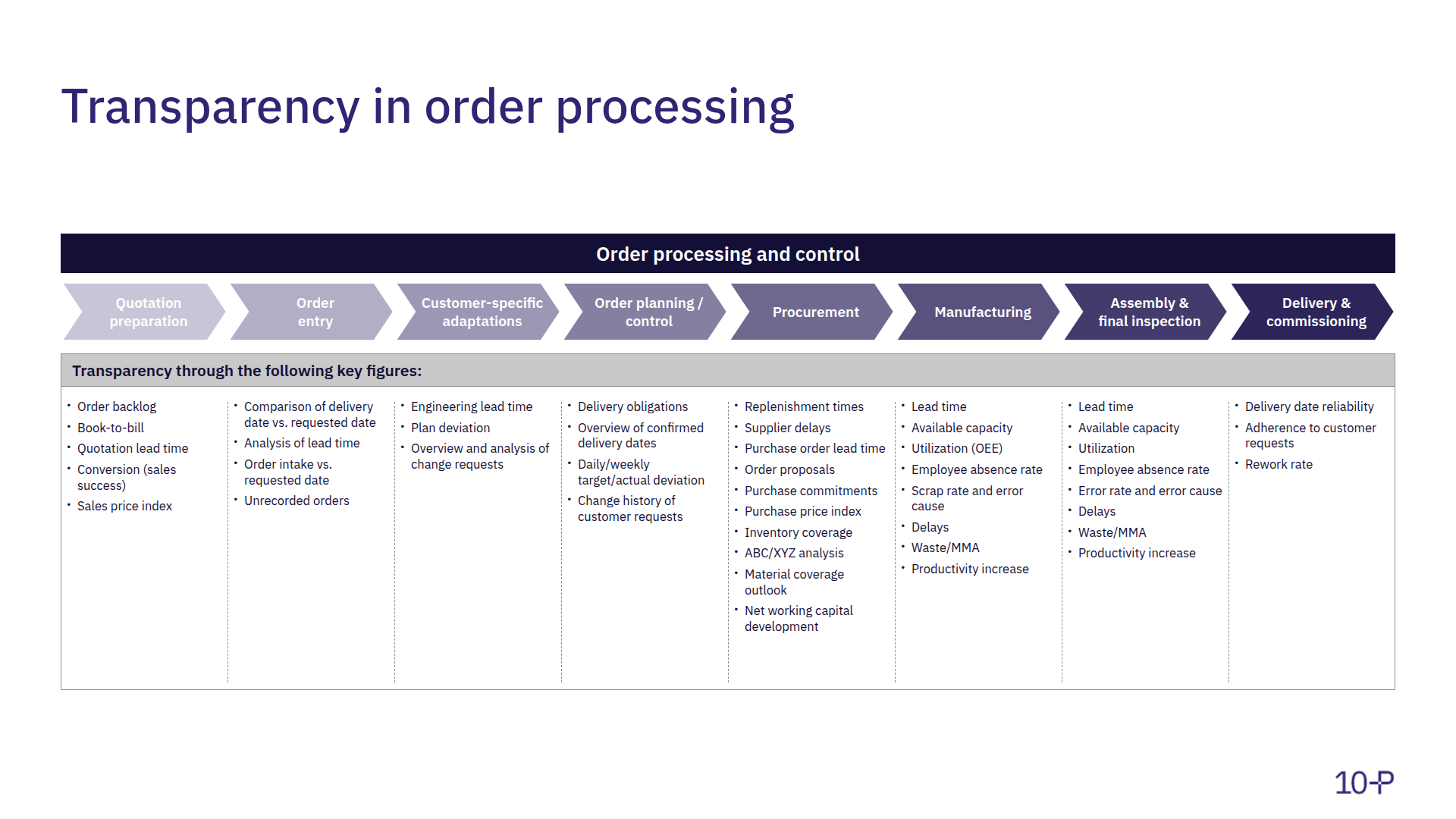
A metrics system that provides the necessary transparency along the order fulfillment process will be decisive for you to steer your processes sustainably and increase delivery reliability. This makes forward-looking steering of your organization possible, so that deviations can be responded to in good time.
Core process: project acquisition
As a further core process, the acquisition of new projects should be mentioned here in brief – a process which, given the appropriate transparency, can likewise lead to reliable statements about your business development.
Here too, a precise understanding of the acquisition workflow in your organization is decisive in order to enable corresponding conclusions about future order intake. A weighted project pipeline tells you about the volume to be expected, while the lead time of individual phases can answer the question of when the order will come in. Furthermore, sales activities can be steered in a more targeted way when the conversion from individual measures and between the acquisition phases is known and systematic deviations can be identified early.
Below, an acquisition process for the development of customer-specific components for mechanical engineering is shown as an example.

Recommendations for the first steps
Before implementing a metrics system, think about which goals you want to achieve. The biggest concerns of your customers – and thus of your sales team – could provide a first clue as to which performance parameters need to be improved.
Before implementation, define the reporting structures and specify exactly which data is to be collected at what frequency and analyzed by which systems. It is not always necessarily sensible to run the same analysis as often and as extensively as possible. A sensible measure keeps costs (effort) and benefits in balance.
Implementing the metrics structure and seeing sustainable results become visible will take more time than customers, managing directors, shareholders, and advisory boards would like. Give the project some time until master data deviations have been identified, process standards have been defined and trained, and corrective measures have been sustainably implemented. Institutional Learning is not a "quick fix" but help for self-help, so that sustainable value is created.
Further articles:
- Institutional Learning #1 (Link)
- Institutional Learning #2 (Link)
- Peak Performance through Transparency - Part 1 / 2 (Link)
Where does your company stand?
The Corporate Health Check quickly shows where your company stands and which levers have the greatest impact. Let's get to know each other in a no-obligation conversation.
Request a meeting

